
HVAC Google Ads: How Consistent Optimization Compounds Into Dramatic Results
HVAC Google Ads: How Consistent Optimization Compounds Into Dramatic Results
11 years of trades Google Ads data — the campaign structure, ad copy framework, and seasonal strategy behind compounding efficiency in HVAC and trades contractor campaigns
HVAC Google Ads campaigns have a specific characteristic that separates them from most other local service verticals: the leads come in waves. A heat wave produces a surge of emergency AC repair calls. The first cold snap of fall produces a surge of furnace repair calls. Between those peaks, the phone slows down. Most HVAC companies respond to this pattern by turning their campaigns on and off with the seasons — and in doing so, they destroy the compounding efficiency that makes Google Ads genuinely powerful over time.
I’m Duncan Lauder, President of Marketing Practicality, and I’ve managed HVAC Google Ads and trades contractor campaigns for over 25 years. The data in this post comes primarily from an 11-year campaign we manage for a multi-generational regional elevator and vertical transportation company serving Pennsylvania, Delaware, New Jersey, and Maryland. While elevator service is a distinct vertical from HVAC, the campaign optimization principles — service type segmentation, seasonal adjustment, conversion rate compounding, and negative keyword discipline — apply directly to HVAC Google Ads. The efficiency trajectory we documented over 11 years is the same trajectory available to any HVAC company willing to invest consistently.

Table of Contents
- Why HVAC Google Ads Work Differently Than Other Channels
- The Data: 11 Years of Trades Campaign Optimization
- HVAC Google Ads Campaign Structure
- HVAC Google Ads Ad Copy That Converts
- HVAC Google Ads Seasonal Strategy
- HVAC Google Ads Negative Keywords
- HVAC Google Ads Landing Pages
- HVAC Google Ads Bidding Strategy
- HVAC Google Ads Implementation Roadmap
- Frequently Asked Questions
Why HVAC Google Ads Work Differently Than Other Channels
HVAC leads come from two distinct search behaviors. The first is emergency search — a homeowner whose AC stopped working on the hottest day of the year is not comparing contractors. They are calling whoever appears first in the search results and answers the phone. The second is planned search — a homeowner researching a furnace replacement or a maintenance agreement is evaluating options and will take more time before deciding.
These two search behaviors require completely different HVAC Google Ads approaches. Emergency searches convert on availability and speed. Planned searches convert on value, financing, and trust signals. Running a single catch-all HVAC campaign with one set of ad copy and one landing page serves neither audience efficiently.
Moreover, HVAC Google Ads have a compounding efficiency characteristic that most contractors don’t take advantage of. A well-managed campaign in year three significantly outperforms the same campaign in year one — not because the market changed, but because the account has accumulated Quality Score history, negative keyword lists, conversion data, and audience signals that make every dollar spent more efficient. This compounding is only available to campaigns that run consistently. Accordingly, the HVAC companies that dominate their markets in paid search aren’t the ones with the biggest budgets — they’re the ones that have been running and actively optimizing year-round for years.
HVAC Google Ads vs. Local SEO:
This post focuses on paid search. For the local SEO strategy — Google Business Profile optimization, seasonal keyword content, and map pack rankings — see our HVAC local SEO guide. For the full HVAC digital marketing strategy covering both channels together, see our HVAC digital marketing peak season guide and HVAC company digital marketing guide.
The Data: 11 Years of Trades Google Ads Campaign Optimization

The following data comes from an 11-year Google Ads campaign we manage for a multi-generational regional elevator and vertical transportation company. This client has operated in the Mid-Atlantic for decades, serving commercial and residential customers across Pennsylvania, Delaware, New Jersey, and Maryland with installation, maintenance, modernization, and repair services.
The campaign optimization principles demonstrated here — service type segmentation, consistent year-round management, negative keyword discipline, and conversion rate compounding — apply directly to HVAC Google Ads. In fact, the trades contractor environment makes the HVAC parallel particularly apt: both involve emergency repair, planned maintenance, and high-ticket replacement as distinct service types requiring distinct campaign approaches.
HVAC Google Ads Compounding: Year-by-Year Conversion Data
| Year | Phone Call Leads | Form Submissions | Total Conversions | Notes |
|---|---|---|---|---|
| 2015 | 42 | 28 | 70 | Campaign launch |
| 2016 | 116 | 85 | 201 | +187% YoY |
| 2017 | 157 | 31 | 188 | Form optimization began |
| 2018 | 145 | 15 | 160 | Campaign restructure |
| 2019 | 93 | 12 | 105 | Market softening |
| 2020 | 66 | 15 | 81 | COVID impact |
| 2021 | 272 | 22 | 294 | Post-COVID surge |
| 2022 | 266 | 34 | 300 | Peak volume |
| 2023 | 273 | 37 | 310 | Highest year |
| 2024 | 196 | 58 | 254 | Form volume growing |
| 2025 | 191 | 114 | 305 | Form fills 2x |
| Total | 1,817 | 451 | 2,395* | Search campaigns only |
*Search campaigns only. All-time search campaign data: 25,909 clicks, $55,748 total spend, $23.28 average CPL, 9.24% conversion rate. 2026 data partial through September 17, 2026.
What the HVAC Google Ads Data Shows
Three things stand out from this data that apply directly to HVAC Google Ads management.
First, the 2019-2020 dip is real and worth acknowledging honestly. Commercial elevator demand softened in 2019 and COVID suppressed it further in 2020. Similarly, an economic downturn or an unusually mild weather year can suppress HVAC search volume. The response in both cases is the same: maintain the campaign at reduced budget rather than pausing it entirely. The account that maintained consistent activity through 2019-2020 launched 2021 from a position of Quality Score strength and account learning that drove the dramatic 2021 surge.
Second, the 2021-2023 surge to 294-310 conversions per year didn’t come from a budget increase. Instead, it came from the accumulated optimization history — Quality Score improvements, negative keyword lists refined over five years, bid strategy algorithms trained on thousands of conversions — producing dramatically better efficiency from the same spend.
Third, the form submission growth from 22 in 2021 to 114 in 2025 reflects a deliberate landing page optimization effort. Specifically, mobile contact forms were simplified, tap-to-call was made more prominent, and the conversion path was reduced from four steps to two. For HVAC Google Ads, this landing page work is often the highest-leverage optimization available — particularly for emergency repair searches where the homeowner has zero patience for friction.
Average cost per lead across 11 years of search campaign management — 2,395 total conversions at $55,748 total spend. The 9.24% conversion rate reflects 11 years of negative keyword discipline, Quality Score building, and landing page optimization compounding into a highly efficient campaign. Full case study →
HVAC Google Ads Campaign Structure

The single most important structural decision in HVAC Google Ads is service type segmentation. One broad “HVAC contractor” campaign competes for everything and converts on too little. Separate campaigns by service type — each with its own keywords, ad copy, and landing page — consistently outperform catch-all campaigns in both Quality Score and conversion rate.
Recommended HVAC Google Ads Campaign Structure
Campaign 1: Emergency AC Repair
The highest-urgency, highest-conversion campaign in the HVAC portfolio. Runs 24 hours a day during cooling season. Ad copy leads with immediate availability. Landing page is optimized for a single action — tap to call. Keywords: “AC not working,” “air conditioner repair near me,” “emergency AC repair [city],” “AC stopped working.” Budget allocation should be highest of all campaigns during cooling season peaks.
Campaign 2: Emergency Furnace Repair
Same structure as emergency AC repair — mirrored for heating season. Activates in October and runs through March. Keywords: “furnace not working,” “no heat,” “emergency furnace repair [city],” “furnace stopped working.” Pre-build this campaign in September so it launches with ad copy tested and Quality Score established before the first cold snap arrives.
Campaign 3: AC Installation and Replacement
Higher ticket, longer consideration timeline than emergency repair. Ad copy leads with financing availability rather than emergency response. Landing page should include system comparison information, financing calculator if available, and a consultation booking form in addition to tap-to-call. Keywords: “AC installation [city],” “new air conditioner cost,” “central AC replacement,” “AC system installation near me.”
Campaign 4: Furnace Installation and Replacement
Same structure as AC installation — mirrored for heating season. Strongest in September and October when homeowners are planning pre-winter replacements before emergency replacements become necessary.
Campaign 5: Maintenance and Tune-Up
Lower urgency, higher volume, strong for recurring revenue and maintenance agreement conversion. Keywords: “AC tune-up [city],” “furnace tune-up near me,” “HVAC maintenance [city],” “air conditioner maintenance.” Ad copy should lead with the maintenance agreement offer and a seasonal urgency message — “Schedule your pre-season tune-up before slots fill.”
Campaign 6: Heat Pump
A growing category as heat pump adoption increases. Covers both installation and service. Keywords: “heat pump installation [city],” “heat pump repair near me,” “heat pump cost.” A separate campaign allows budget allocation that reflects this category’s growing search volume without diluting the established emergency repair campaigns.
HVAC Google Ads Ad Copy That Converts

The principle driving effective HVAC Google Ads copy is the same principle that drives effective criminal defense ad copy: meet the emotional state of the searcher, not the credentials of the contractor. A homeowner whose AC stopped working in July is not evaluating your years in business. They are evaluating whether you can come today and fix it now.
HVAC Google Ads Emergency Repair Copy
HVAC Google Ads Replacement Copy
HVAC Google Ads Ad Extensions That Matter
- Call extensions — non-negotiable for emergency repair campaigns. The homeowner without AC in July wants to call, not fill out a form. A call extension that rings directly to a dispatcher during business hours converts significantly better than a form-only landing page.
- Location extensions — shows your service area directly in the ad. Particularly important for HVAC where the homeowner is filtering for local providers.
- Sitelink extensions — link to financing information, maintenance agreements, and specific service types. Sitelinks expand your ad footprint and provide additional paths to conversion beyond the main headline click.
- Promotion extensions — seasonal tune-up specials, financing offers, and new customer discounts can be promoted directly in the ad without consuming headline space.
HVAC Google Ads Seasonal Strategy
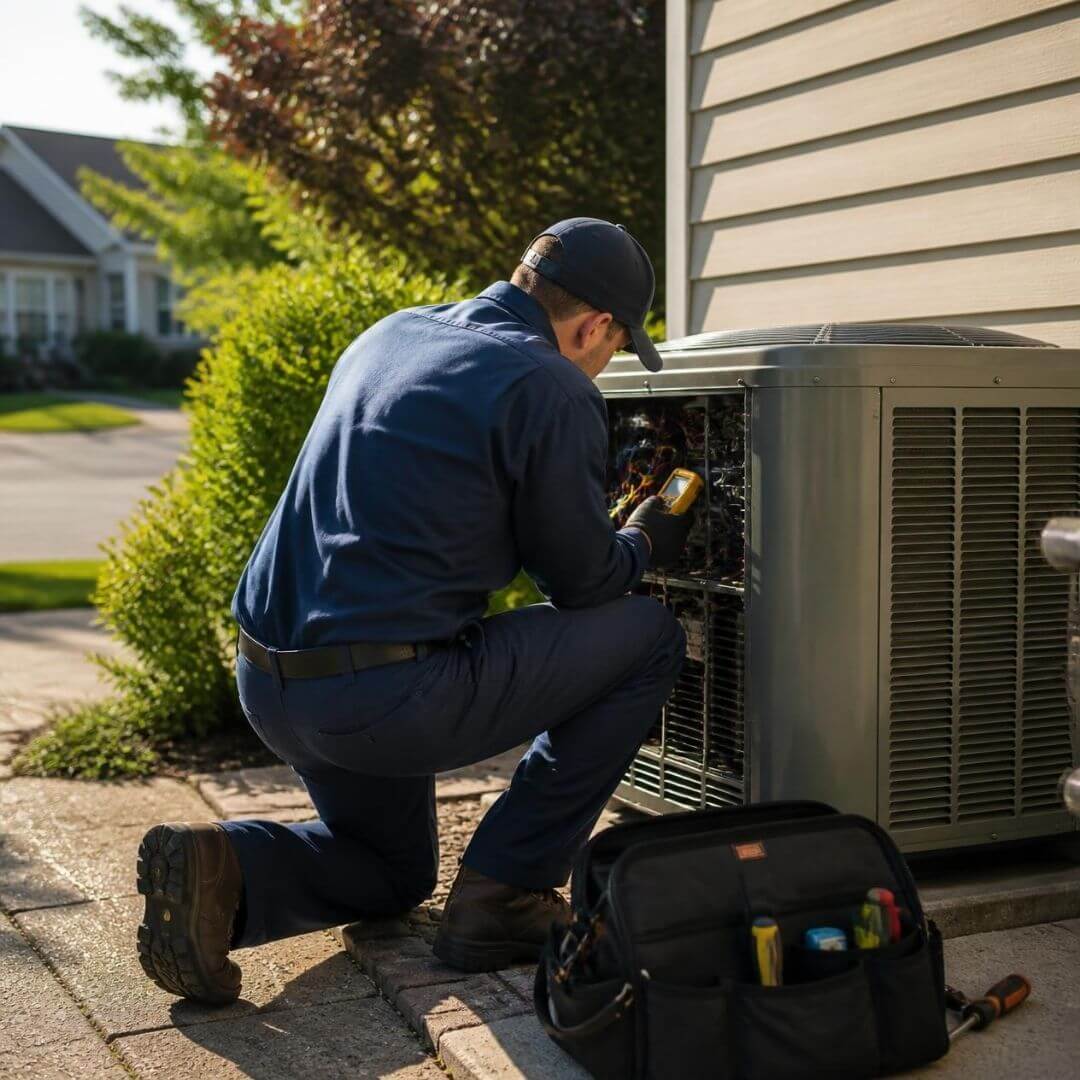
Seasonal management is the most distinctive aspect of HVAC Google Ads compared to other trades verticals. No other home service category has demand swings as dramatic as HVAC — search volume for AC repair can increase 300-400% during a heat wave, and furnace repair searches spike similarly during the first cold snap of fall.
HVAC Google Ads Cooling Season Strategy (May–September)
- Emergency AC repair campaigns at full budget with 24/7 scheduling. A homeowner whose AC fails at 9 PM on a Saturday is searching at 9 PM on a Saturday. A campaign that pauses at 6 PM misses the highest-urgency leads of cooling season.
- Bid adjustments activated for heat wave days. When temperatures forecast above 95°F, increase bids for emergency repair keywords by 30-50%. Search volume spikes during heat events and the leads generated are the highest-intent of the entire year.
- AC replacement campaigns running alongside emergency repair. A homeowner whose older unit failed in July is simultaneously an emergency repair lead and a replacement consideration lead. Running replacement campaigns captures both intents.
- Maintenance campaigns running for tune-up business. The shoulder months of May and September are peak maintenance search periods. Running maintenance campaigns in these windows generates recurring revenue leads at lower competition than peak emergency periods.
HVAC Google Ads Heating Season Strategy (October–April)
- Emergency furnace repair campaigns pre-built and launched in October. The first cold snap of the year produces a surge in “furnace not working” searches. The HVAC companies capturing those leads have their heating campaigns running before the cold arrives — not being built in response to it.
- Furnace replacement campaigns active through November. October and November are the peak months for planned furnace replacement — homeowners who want to replace before winter rather than risk an emergency replacement in February. Replacement campaigns with financing messaging convert well in this window.
- Reduced but maintained AC campaigns through winter. AC searches don’t go to zero in winter. Homeowners in warmer climates, rental property owners, and commercial customers search year-round. Maintaining AC campaigns at reduced budget through winter preserves Quality Score and account learning for the spring surge.
HVAC Google Ads Negative Keywords
Negative keyword management is among the most consistently undervalued optimizations in HVAC Google Ads. Every irrelevant search that triggers your ad costs money, dilutes your conversion rate, and signals low relevance to Google’s Quality Score algorithm. Over 11 years of trades campaign management, we have added hundreds of negative keywords — and each one represents a small, compounding CPL improvement.
HVAC Google Ads Negative Keyword Categories
DIY and Repair Yourself:
- “How to fix AC,” “DIY furnace repair,” “AC repair yourself,” “how to recharge AC,” “furnace filter replacement how to”
Parts and Equipment Only:
- “AC parts,” “furnace parts,” “HVAC parts near me,” “air filter,” “thermostat,” “AC compressor price”
Career and Education:
- “HVAC technician salary,” “HVAC school,” “HVAC certification,” “how to become HVAC technician,” “HVAC apprenticeship”
Rental and Portable Units:
- “Portable AC unit,” “window AC unit,” “AC rental,” “portable heater,” “space heater”
Competitor Brand Names:
- Add specific competitor names as negatives if you don’t want to appear on branded searches for competitors you’re not trying to capture
Review your search terms report monthly in active season and quarterly in slow season. Add negative keywords consistently. The improvement compounds over time in exactly the way the data table above demonstrates.
HVAC Google Ads Landing Pages
The landing page is where HVAC Google Ads campaigns win or lose leads. A well-structured campaign gets the click. The landing page determines whether that click becomes a call or a form submission.
HVAC Google Ads Emergency Repair Landing Pages
Emergency repair landing pages have one job: make it as easy as possible to call right now. Specifically, this means:
- Tap-to-call phone number visible above the fold without scrolling — the most important element on the page
- Service confirmation in the H1: “Emergency AC Repair — [City]” confirms the homeowner landed in the right place
- Availability signal immediately below the headline: “Available 24/7 — Same Day Service”
- Three-field contact form as the alternative to calling — name, phone number, brief description of the issue
- Mobile load time under 2.5 seconds — every second of load time costs conversions from a stressed homeowner
- No navigation menu — eliminate every exit path that isn’t a call or a form submission
HVAC Google Ads Replacement Landing Pages
Replacement and installation landing pages serve a different audience with a longer decision timeline. In addition to the conversion basics above, these pages should include financing information prominently, a brief system comparison or recommendation tool, and social proof — reviews, warranties, certifications — that builds trust for a higher-ticket decision.
HVAC Google Ads Bidding Strategy
The right HVAC Google Ads bidding strategy changes as the account matures — the same progression documented in the 11-year trades campaign data above.
Early Stage: Manual CPC
New HVAC Google Ads campaigns with limited conversion history should start with manual CPC bidding. This gives direct control over position and spend while the account builds the conversion data that machine learning requires. Target top-of-page position for emergency repair keywords and allow slightly lower positions for maintenance and replacement keywords while the account learns.
Mid Stage: Target CPA After 30+ Monthly Conversions
Once the campaign generates at least 30 conversions per month consistently, Target CPA bidding becomes viable. Set the initial target CPA at 20-30% above the current actual CPA, then tighten it over time as the algorithm learns which auctions produce conversions efficiently. This transition typically produces noticeable improvement in conversion volume at stable or lower CPL within 4-6 weeks.
Mature Stage: Maximize Conversions with Target CPA
A mature HVAC Google Ads account — like the trades campaign documented here with 11 years of conversion history — runs most efficiently on Maximize Conversions with a target CPA constraint. The algorithm has deep auction intelligence built over thousands of conversions across search terms, geographic patterns, time-of-day signals, and device preferences. Overriding that intelligence with manual bids at this stage typically makes performance worse.
HVAC Google Ads Implementation Roadmap
Phase 1: Campaign Build (Month 1–2)
- Keyword research by service type — emergency repair, installation, maintenance, heat pump
- Campaign structure build — separate campaigns for each service type
- Ad copy development — availability-first for emergency, financing-first for replacement
- Landing page audit or build — service-type specific pages with mobile optimization
- Conversion tracking setup — calls, form fills, and chat by source and campaign
- Negative keyword seed list from HVAC category above
- Manual CPC bidding with target position goals
Phase 2: Optimization (Month 2–6)
- Monthly search terms report review — add negative keywords, identify new ad group opportunities
- A/B testing of ad headlines — availability vs. urgency, financing vs. credentials
- Landing page conversion rate tracking — identify pages underperforming vs. campaign average
- Geographic bid adjustments — increase bids in highest-converting zip codes
- Ad scheduling optimization — identify highest-converting hours and days by campaign
- Quality Score monitoring — identify low-score ad groups for restructuring
- Transition to Target CPA once 30+ monthly conversions achieved
Phase 3: Seasonal Scaling (Month 6–12+)
- Pre-season campaign preparation — heating campaigns built in September, cooling campaigns reviewed in March
- Heat wave and cold snap bid adjustment protocols established
- Maintenance agreement campaign added for shoulder season revenue
- Heat pump campaign added as separate campaign
- Annual campaign audit — full restructure if conversion rate improvement has plateaued
- Local SEO integration — align HVAC Google Ads and GBP strategy for maximum local visibility
Frequently Asked Questions About HVAC Google Ads
How much should an HVAC company spend on Google Ads?
In competitive urban markets, a meaningful HVAC Google Ads campaign requires $3,000–$6,000 per month in ad spend. In smaller markets, $1,500–$3,000 per month can be effective. The more important number is cost per lead — not total spend. A well-optimized HVAC Google Ads campaign should target $20–$50 per lead in most markets. Running separate campaigns for emergency repair, maintenance, and replacement allows precise budget allocation by service type and conversion value.
What is a good conversion rate for HVAC Google Ads?
A well-optimized HVAC Google Ads campaign should target 8–15% conversion rate for search campaigns. Emergency repair keywords typically convert at higher rates because the homeowner has immediate, urgent need. Early-stage campaigns often run at 2–4% and improve significantly as negative keywords are added, ad copy is refined, and landing pages are optimized for mobile.
Should HVAC companies run Google Ads year-round or only during peak season?
Year-round, with budget and messaging adjusted by season. HVAC Google Ads campaigns that pause during slow periods lose Quality Score history, account learning, and ad position momentum that takes months to rebuild. The efficiency cost of restarting a paused campaign is significantly higher than maintaining it at reduced spend. The 11-year trades campaign documented here demonstrates exactly this: the 2021 surge to 294 conversions was only possible because the account maintained consistent activity through the 2019-2020 dip rather than pausing.
How do you structure Google Ads campaigns for an HVAC company?
Separate campaigns by service type: emergency AC repair, emergency furnace repair, AC installation, furnace installation, maintenance and tune-up, and heat pump. Each campaign should have its own ad groups, ad copy, and landing page. This structure improves Quality Scores, reduces CPCs, and allows precise budget allocation by service type performance — with emergency repair getting the highest budget allocation during peak season.
What ad copy works best for HVAC Google Ads?
Availability-first messaging for emergency repair — “AC Not Working? Available Today — Call Now” consistently outperforms “Experienced HVAC Contractor” in click-through rate and conversion rate. Financing-first messaging for replacement — “New AC System — 0% Financing Available” — removes the primary conversion barrier for high-ticket planned replacements. Match the ad copy to the emotional state of the searcher, not the credentials of the contractor.
What Marketing Practicality delivers for HVAC Google Ads:
- Campaign structure built around service type segmentation from day one
- Availability-first emergency copy and financing-first replacement copy tested and refined
- Seasonal campaign infrastructure built before peak season — not after it arrives
- Monthly search terms review and negative keyword management
- Landing page optimization focused on mobile emergency conversion
- Transparent reporting: cost per lead by campaign, conversion rate by service type, year-over-year trajectory
Also see our free HVAC digital marketing checklist — a complete 58-point audit covering Google Ads, local SEO, seasonal strategy, and lead tracking.

The Compounding Is Real. The Timeline Is Longer Than You Think.
The 11-year trades campaign documented in this post didn’t produce $23.28 CPL in year one. It produced it through consistent optimization applied year after year — negative keywords added monthly, ad copy tested and refined, landing pages improved, seasonal strategies developed and repeated.
The HVAC Google Ads campaigns that produce the best results over time aren’t the ones with the biggest launch budgets. Rather, they are the ones with the most consistent management history. The compounding that makes a mature campaign dramatically more efficient than a new one is only available to campaigns that run continuously and are actively managed throughout.
Start with campaign structure. Build separate campaigns for emergency repair, installation, and maintenance. Give each one its own ad copy and landing page. Run them year-round. Optimize monthly. The efficiency trajectory in the data above is the result of doing exactly that, consistently, for eleven years.
Get a Free HVAC Google Ads Analysis
Share your current campaign details and we’ll show you exactly where your biggest efficiency opportunities are — campaign structure, ad copy, landing pages, and seasonal strategy.
Ready to build an HVAC Google Ads system that compounds over time?
Get a free campaign audit — we’ll show you exactly where your current HVAC campaign is losing efficiency and what a structured optimization path looks like.
Schedule Your Free Strategy SessionFamily Law Google Ads: $83 to $17 CPL in 5 Years
How One Family Law Firm Cut Cost Per Lead from $83 to $17 — and Generated 871 Qualified Leads Five years of Google Ads data…
Bankruptcy Leads: Should You Buy Them or Build Your Own with Google Ads?
Bankruptcy Leads: Should You Buy Them or Build Your Own with Google Ads? A data-driven look at what purchased leads actually cost — and why…
Electrical Contractor Marketing: The Proven Guide
Electrical Contractor Marketing: The Proven System for Growing Your Electrical Business Google Ads, local SEO, and the compounding system behind electrical contractor marketing that generates…