
Bankruptcy Leads: Should You Buy Them or Build Your Own with Google Ads?
Bankruptcy Leads: Should You Buy Them or Build Your Own with Google Ads?
A data-driven look at what purchased leads actually cost — and why the real question is what you do after the lead arrives.
My name is Duncan Lauder. I’m the founder of Marketing Practicality and I’ve been running digital marketing campaigns for attorneys and contractors for 25 years. I’ve managed Google Ads for a New Jersey consumer bankruptcy attorney for over a decade, and the question he recently asked me — should I buy leads or keep running Google Ads? — is one I hear from nearly every attorney who’s built a working campaign. Here’s what I told him, and why the answer is more nuanced than most marketing agencies will admit.
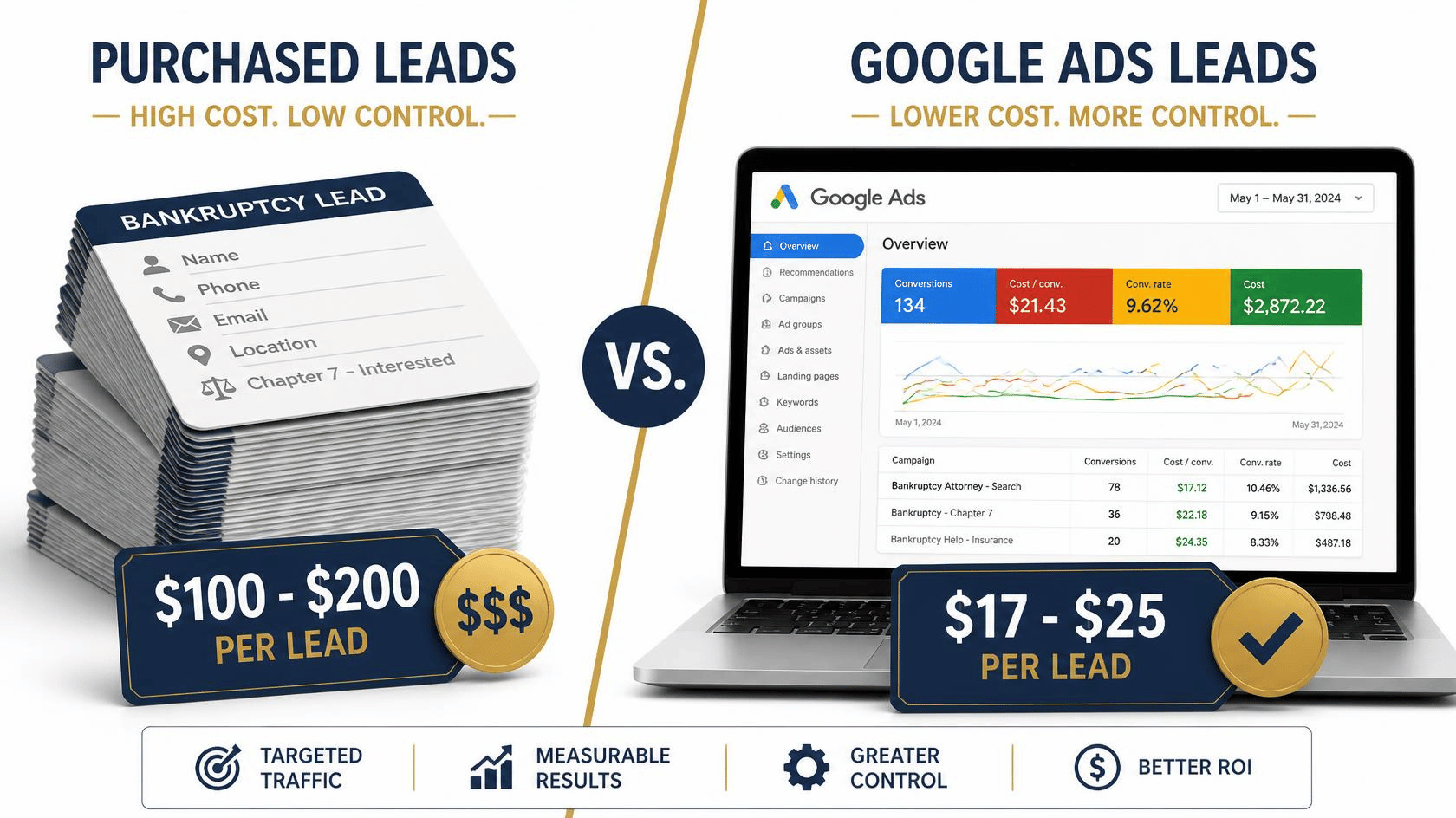
The Question Every Busy Bankruptcy Attorney Eventually Asks
It usually comes after a good month. The leads are coming in. The phone is ringing. But somewhere in the stack of consultations, there are people who don’t have enough debt, don’t qualify for Chapter 7, already have an attorney, or — most frustratingly — just wanted information and never intended to hire anyone.
The math starts to bother you: if you’re paying $25 per lead and only one in four is someone you’d actually take on as a client, your real cost of acquiring a client is closer to $100. And if a competing lead vendor is promising pre-qualified, exclusive bankruptcy leads for $150 each, it starts to sound like a better deal.
It might be. Or it might not. The answer depends almost entirely on a variable most marketing agencies never talk about: your intake process.
The core argument of this post: Google Ads wins on cost per lead. Purchased leads can win on lead quality. Which one produces a lower cost per signed case depends on how efficiently you qualify the leads you get — not where they come from.
What Purchased Bankruptcy Leads Actually Cost
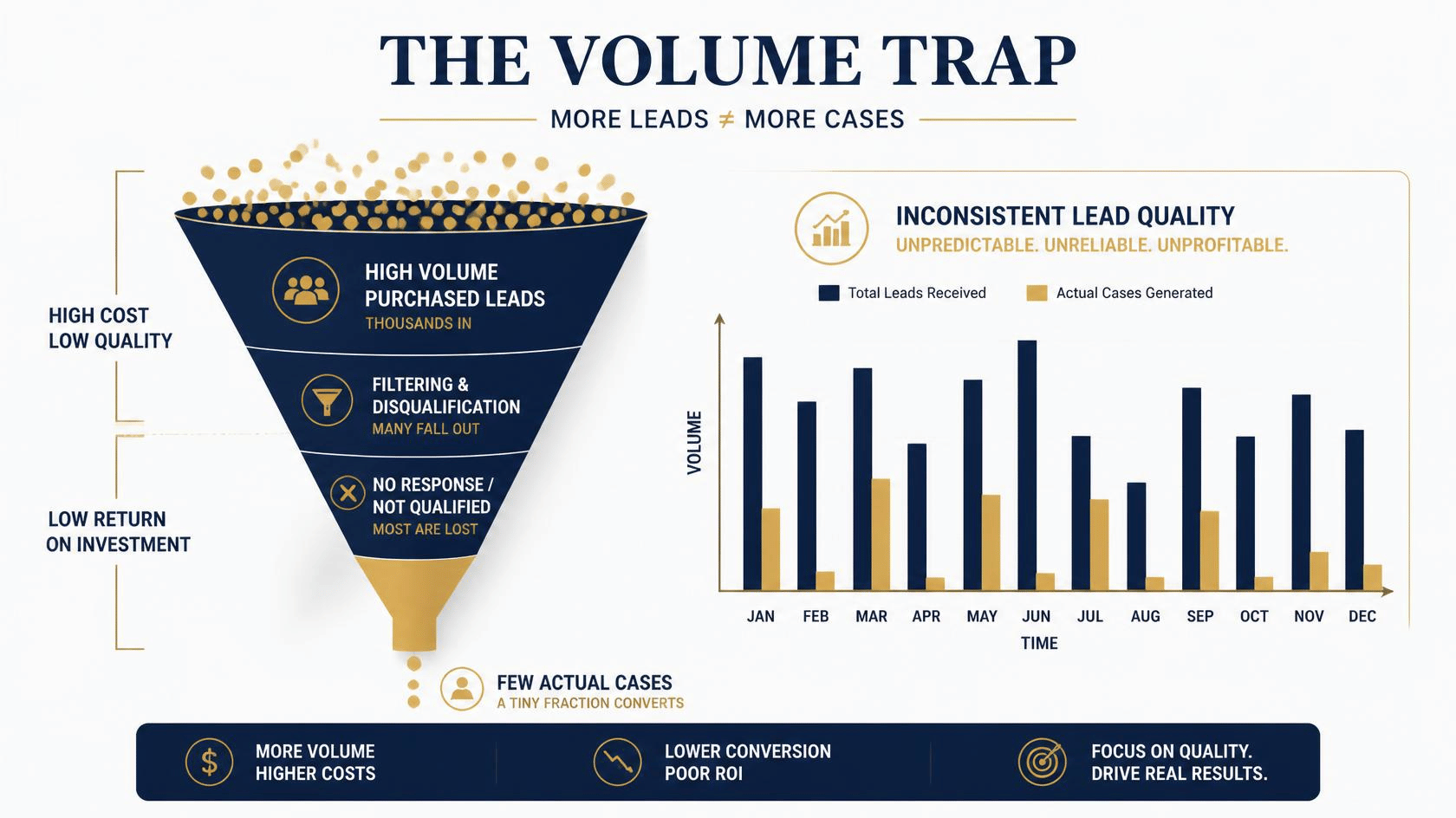
The legal lead generation market has consolidated around a few pricing tiers. Here’s what third-party bankruptcy leads typically cost and what you get for the money:
| Lead Type | Cost Per Lead | Exclusivity | Est. Close Rate | Est. Cost Per Signed Case |
|---|---|---|---|---|
| Shared marketplace leads (LegalMatch, Avvo, directories) |
$30–$75 | Sold to 3–5 attorneys simultaneously | 3–8% | $375–$2,500 |
| Exclusive purchased leads | $100–$200 | Sold to one firm | 15–30% | $333–$1,333 |
| Pre-screened referral leads (e.g., Upsolve attorney network) |
Varies by market | Varies | Varies — higher intent | Unknown without testing |
| Google Ads (managed, optimized) | $17–$25 | Exclusive — goes to your firm only | 20–28% | $65–$125 |
Sources: Legal Brand Marketing, PeakIntent, ENX2 Marketing. Google Ads figures from Marketing Practicality client data.
The shared marketplace numbers deserve special attention. Paying $50 for a lead that’s simultaneously being called by four other bankruptcy attorneys is rarely a bargain. Speed-to-contact becomes the only differentiator — and whoever calls first wins the case, not the best attorney.
One important caveat on purchased leads: Close rate data from lead vendors should be treated skeptically. Vendors have an obvious incentive to report favorable conversion numbers. The only close rate that matters is the one you measure yourself.
What Google Ads Actually Produce: 12 Years of Real Data
The table above includes Google Ads numbers from a real campaign — a New Jersey consumer bankruptcy attorney we’ve managed since 2015. Here’s the full year-by-year picture:
| Year | Conversions | Cost Per Lead | Conversion Rate |
|---|---|---|---|
| 2015 (Q4 only) | 15 | $218.15 | 4.7% |
| 2016 | 78 | $179.38 | 5.9% |
| 2017 | 92 | $161.44 | 6.2% |
| 2018 | 88 | $148.72 | 6.8% |
| 2019 | 97 | $134.90 | 7.1% |
| 2020 | 103 | $119.55 | 7.9% |
| 2021 | 105 | $208.76 | 2.9% |
| 2022 | 422 | $62.88 | 13.3% |
| 2023 | 687 | $38.14 | 17.6% |
| 2024 | 1,030 | $21.08 | 21.9% |
| 2025 | 1,098 | $26.62 | 18.3% |
| 2026 (YTD) | 1,404 | $17.95 | 27.8% |
A few things worth noting in this data:
2021 was an anomaly. Cost per lead spiked to $208 while conversions barely moved. That’s not a campaign failure — it’s the post-pandemic period when bankruptcy filings collapsed nationally as stimulus payments and eviction moratoriums kept people solvent temporarily. The campaign kept running through it. That decision mattered.
2022 was the inflection point. Conversions jumped from 105 to 422 in a single year. Conversion rate went from 2.9% to 13.3%. This wasn’t a campaign change — it was the combination of compounded Quality Score improvements paying off as economic conditions normalized. This is what long-term optimization compounding looks like in practice.
The CPL story is the headline. From $218 in 2015 to $17.95 today. That’s a 92% reduction over 12 years. No third-party lead source comes close to that number at scale.
For more detail on how this campaign was built and optimized, see our full bankruptcy attorney digital marketing case study.
The Volume Trap: Why More Leads Isn’t Always the Answer
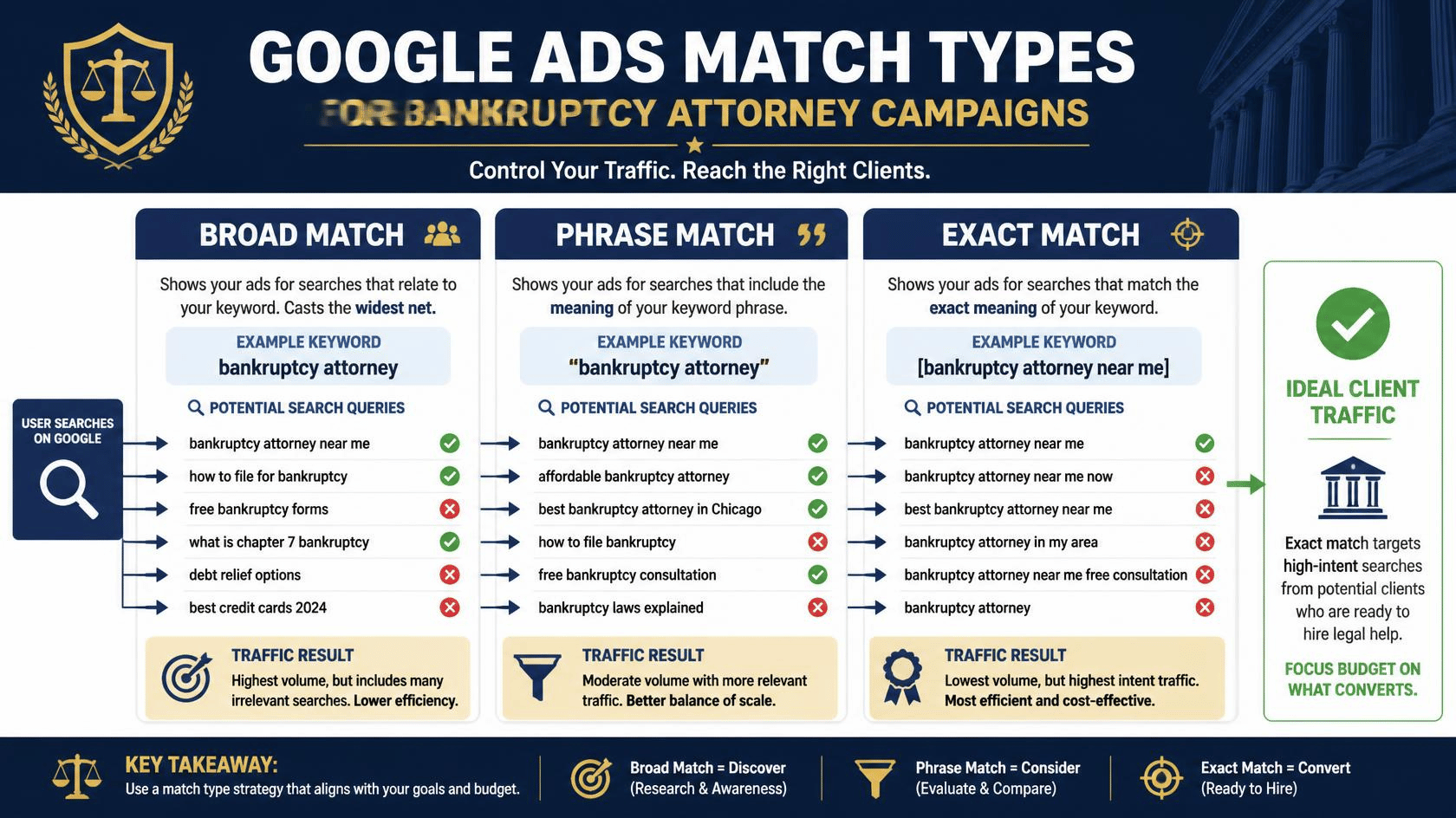
Here’s the problem that prompted my client’s question in the first place: he was generating more leads than ever, but too many of them weren’t converting. He wanted to know if the solution was to buy better leads — or to tighten up the ones he was already generating.
This is the volume trap. It looks like a lead quality problem. It’s often an intake problem in disguise.
Consider two scenarios:
100 leads/month at $20 CPL = $2,000 spend
20 qualify after intake screening
Effective CPL on qualified leads: $100
Intake time wasted: 80 calls × 15 min = 20 hours
100 leads/month at $20 CPL = $2,000 spend
20 qualify after 3-minute screening call
Effective CPL on qualified leads: $100
Intake time wasted: 80 calls × 3 min = 4 hours
The cost per qualified lead is identical. But Scenario B reclaims 16 hours of attorney or staff time per month. Across a year, that’s nearly 200 hours — the equivalent of five full work weeks — recovered simply by improving intake efficiency, not by changing where leads come from.
This is why I tell attorneys: before you change your lead source, change your intake process. The ROI is almost always better.
Google Ads Match Types and Lead Quality
If intake optimization isn’t enough — or if budget is tight and you genuinely can’t handle high volume — there is a legitimate Google Ads lever for improving lead quality: tightening keyword match types.
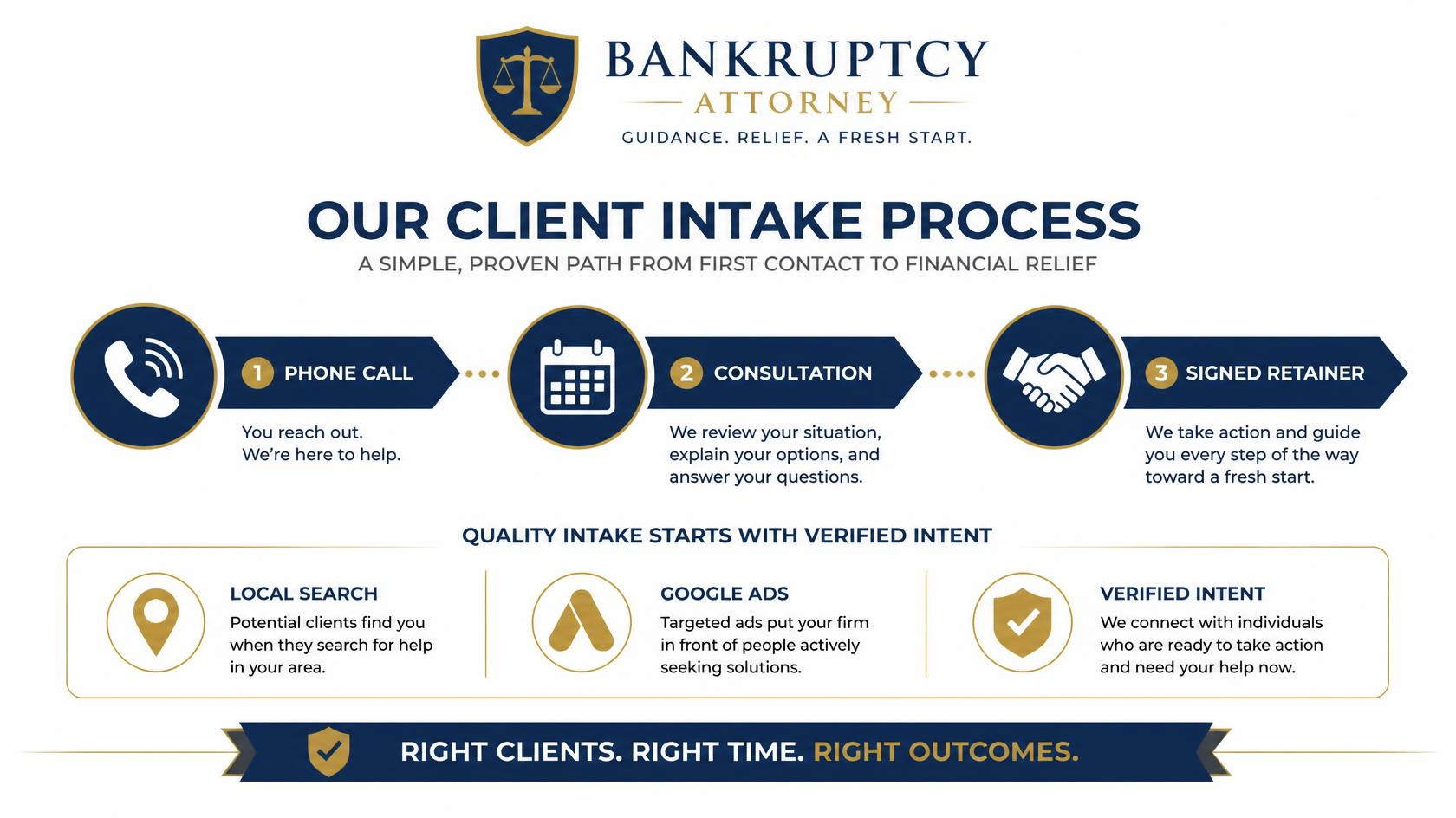
Google Ads offers three main match types, each with a different tradeoff between volume and intent:
| Match Type | How It Works | Lead Volume | Lead Quality | CPL Impact |
|---|---|---|---|---|
| Broad Match | Ads show for searches Google deems “relevant” — often loosely | High | Lower | Lowest CPL, most waste |
| Phrase Match | Ads show when query contains your keyword phrase in order | Medium | Medium | Moderate CPL |
| Exact Match | Ads show only for searches that closely match your exact term | Lower | Highest | Highest CPL, least waste |
High-Intent Exact Match Keywords for Bankruptcy
If you shift toward phrase and exact match, these are the terms that tend to signal genuine hire intent:
- “bankruptcy attorney near me”
- “chapter 7 bankruptcy lawyer [city]”
- “file bankruptcy attorney”
- “how to file chapter 7 with an attorney”
- “bankruptcy consultation”
The tradeoff is real: Moving from broad to phrase/exact match in a mature campaign will typically raise your CPL by 30–70% while reducing lead volume by a similar margin. Whether that’s worth it depends on your intake capacity, your budget, and how much attorney time unqualified leads are consuming. We always recommend testing before committing to a full match type shift — run both in parallel for 60–90 days before drawing conclusions. See our full guide on bankruptcy attorney Google Ads for more on campaign structure.
What About Pre-Screened Leads Like Upsolve?
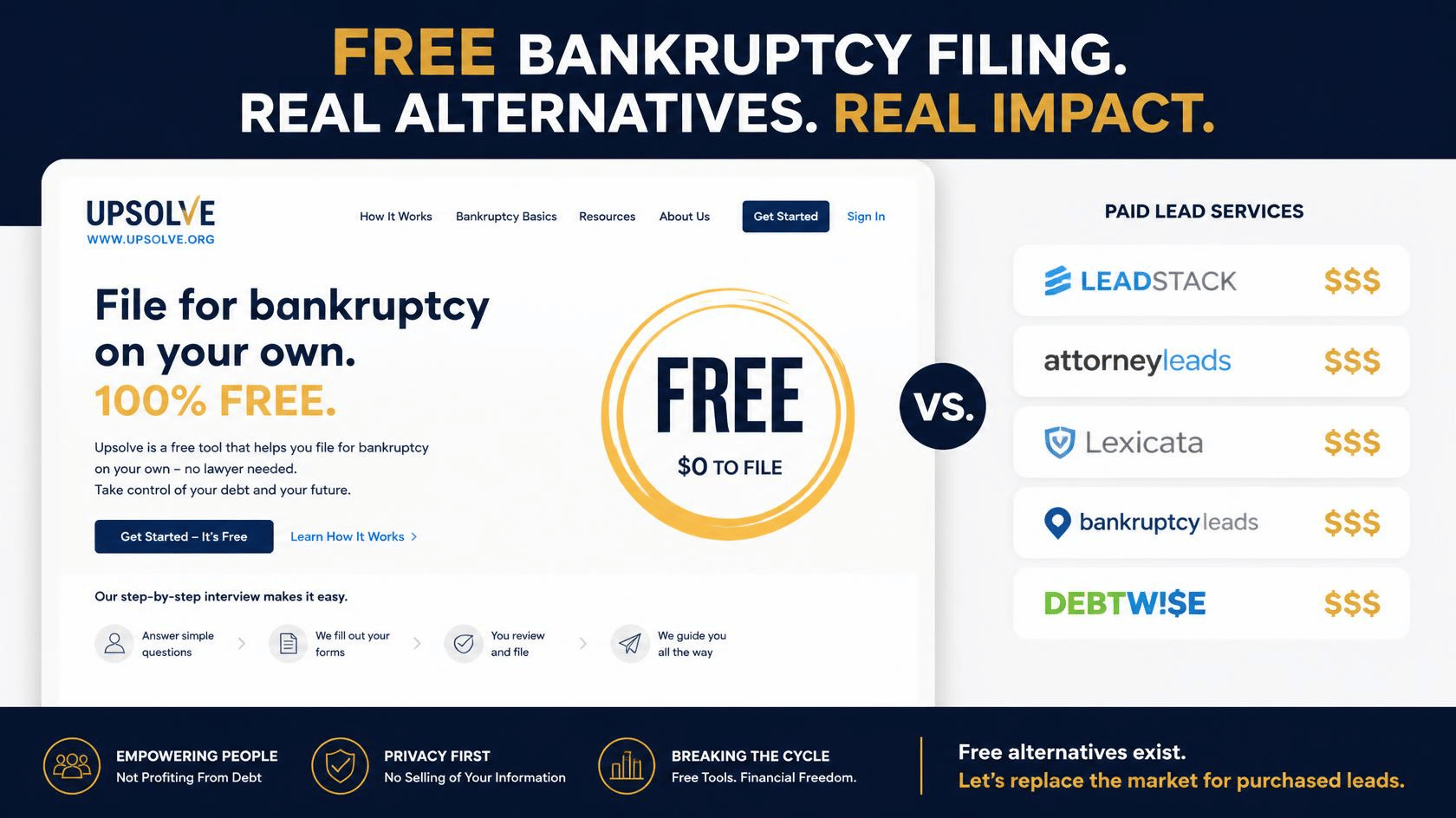
Upsolve is a nonprofit that helps people file Chapter 7 bankruptcy for free. People who use their platform but don’t qualify for free filing — typically because their case is too complex, involves assets, or includes non-dischargeable debt — are sometimes referred to attorneys in their area.
These leads are genuinely different from a purchased list in one important way: they’ve already confirmed they need help. They went through the Upsolve intake process, discovered they needed an attorney, and are now being referred to one. That’s a meaningful pre-screening step that most lead vendors don’t provide.
What We Don’t Know About Upsolve Leads
The honest answer is that Upsolve attorney leads are relatively new as a commercial product, and published performance data is limited. What we know:
- They’re people who tried to file themselves and couldn’t — suggesting real need but possibly complex cases
- Complex cases can mean higher value or more time-intensive work, depending on the specifics
- Geographic availability and lead volume vary significantly by market
- Pricing and exclusivity terms can differ from standard lead vendor models
My recommendation to my client was to test them — run a defined budget for 90 days, track close rate and case value carefully, and compare directly against his Google Ads metrics for the same period. That’s the only way to know if they work in his market with his practice profile.
The principle applies to any lead source: never buy leads indefinitely without measuring close rate and case value at the individual source level. A $150 lead that closes at 40% beats a $20 lead that closes at 5% — but you have to track it to know which you have.
The Real Lever: Your Intake Process
I’ve said this twice already, and I’ll say it one more time because it’s the most actionable takeaway in this post: before you change where your leads come from, fix how you handle the leads you’re already getting.
Here’s what a strong bankruptcy intake process looks like:
Immediate Response (Within 5 Minutes)
Speed-to-contact is the single biggest variable in bankruptcy lead conversion. Studies consistently show that responding within 5 minutes increases conversion rates dramatically versus responding within an hour. This applies whether you bought the lead or generated it yourself.
Three-Minute Screening Call
You don’t need a 30-minute intake call to know if someone qualifies. Three questions tell you most of what you need: What kind of debt? How much? Have you filed before? A trained staff member can run this call, flag qualified leads for consultation scheduling, and politely end calls with people who don’t qualify — without consuming attorney time.
Disqualify Quickly and Gracefully
The best thing you can do for an unqualified lead is tell them quickly and clearly that you can’t help them — and ideally point them toward a resource that can. It’s good practice, and it’s the right thing to do for someone who’s already in financial distress.
Track Source-Level Close Rates
If you have Google Ads leads, purchased leads, and referral leads all coming in, you need to know which source closes at what rate. Most attorneys track total leads and total cases signed, but not the path between them. Without source-level data, you’re making expensive decisions in the dark.
The attorneys who tell me their leads are “low quality” almost always have an intake problem, not a lead source problem. The ones who’ve fixed their intake tell me their leads got better — even though nothing about the campaigns changed.
The Verdict: Which Source Wins?
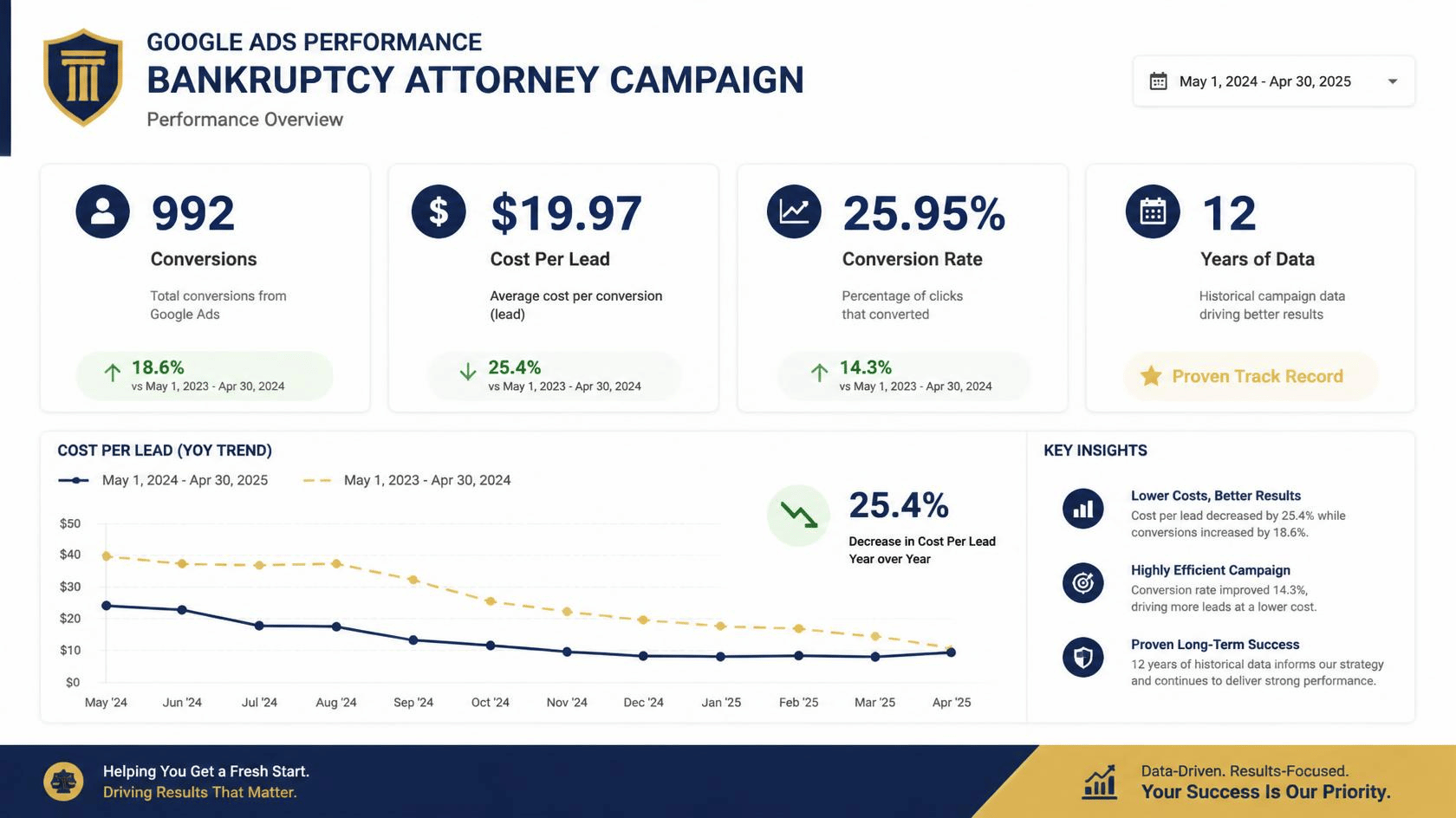
Based on 12 years of real campaign data and an honest look at what the purchased lead market offers, here’s how the math works out for most bankruptcy practices:
| Source | Best For | Worst For |
|---|---|---|
| Google Ads (optimized) | Practices with strong intake, consistent budgets, and patience for a 2–3 year build | Practices that need volume immediately or can’t handle lead screening |
| Exclusive purchased leads | Practices that need immediate volume without a campaign build period | Practices comparing true cost per signed case — rarely beats a mature Google Ads campaign |
| Shared marketplace leads | Testing a new market with minimal investment | Any practice that wants predictable quality — competing with 4 other attorneys for the same lead is rarely worth it |
| Pre-screened referral leads (Upsolve) | Practices open to testing newer channels; higher-intent audience | Practices without 90-day testing budget to measure independently |
The honest answer is that for a practice with a mature Google Ads campaign running at $17–$25 CPL, purchased leads are almost never a better buy on a cost-per-case basis. But the CPL comparison misses the real question: are you converting the leads you already have?
If the answer is no — fix intake first. If intake is strong and you still want volume diversification, test a purchased source with a defined budget and timeline. Just measure it.
What a Well-Managed Campaign Actually Delivers
- Cost per lead: $17–$25 (vs. $100–$200 for exclusive purchased leads)
- Conversion rate: 20–28% with proper landing page and intake
- Exclusivity: 100% — every lead goes only to your firm
- Cost per signed case: $65–$125 at current performance levels
- Trajectory: CPL decreases year over year as Quality Score compounds
For more detail on the metrics that actually matter in a bankruptcy campaign, see our post on conversion rate and cost per lead. And if your practice is evaluating its full marketing picture, the bankruptcy attorney marketing checklist is a good starting point.
Frequently Asked Questions
How much do purchased bankruptcy leads cost?
Purchased bankruptcy leads typically cost $30–$75 for shared leads (sold to multiple attorneys) and $100–$200 for exclusive leads (sold to one firm). Shared leads convert at 3–8%, while exclusive leads convert at 15–30%. By comparison, a well-optimized Google Ads campaign can generate bankruptcy leads for $17–$25 with conversion rates above 20%.
Are purchased bankruptcy leads worth it?
Purchased leads can make sense as a short-term bridge or supplement, but they rarely outperform a mature Google Ads campaign on cost per signed case. The key variable is your intake process: if you can qualify leads quickly, Google Ads volume becomes your advantage. If your intake is slow or inconsistent, the cheaper CPL doesn’t translate to lower cost per case.
What is a good cost per lead for a bankruptcy attorney?
Industry benchmarks put bankruptcy attorney CPL at $40–$150 from third-party sources. With a well-managed Google Ads campaign, we’ve consistently seen CPL fall to $17–$25 after 2–3 years of optimization. The more meaningful metric is cost per signed case, which accounts for your intake conversion rate.
What are Upsolve attorney referral leads?
Upsolve is a nonprofit that helps people file Chapter 7 bankruptcy for free. People who use Upsolve but don’t qualify for free filing — typically because their case is too complex — are referred to attorneys. These leads are pre-screened in one important way: they’ve already confirmed they need bankruptcy help. Their quality varies by case complexity and geographic market.
How do I improve bankruptcy lead quality from Google Ads?
The most effective lever is tightening keyword match types from broad to phrase or exact match on high-intent terms. This reduces total lead volume but improves qualification rate. The tradeoff: CPL increases, often significantly. Before cutting volume, evaluate your intake process — a faster, better-scripted intake call often solves the quality problem without sacrificing lead volume.
Should bankruptcy attorneys use broad, phrase, or exact match keywords?
There is no universal answer. Broad match generates the most volume but includes low-intent searches. Phrase and exact match reduce volume but target higher-intent queries. The right mix depends on your market size, budget, and intake capacity. In competitive urban markets, phrase and exact match on terms like “file bankruptcy attorney” or “chapter 7 bankruptcy lawyer near me” tend to produce the best qualified leads.
Is Your Bankruptcy Campaign Producing the Leads It Should?
We’ll look at your actual data — CPL, CVR, match types, intake workflow — and tell you exactly where the problem is.
Duncan Lauder is the founder of Marketing Practicality, a digital marketing agency based in Kennett Square, PA. He has managed Google Ads campaigns for legal and trades clients for 25 years, with a specialty in high-intent local campaigns that produce measurable, compounding results. Learn more about Marketing Practicality.
Bankruptcy Leads: Should You Buy Them or Build Your Own with Google Ads?
Bankruptcy Leads: Should You Buy Them or Build Your Own with Google Ads? A data-driven look at what purchased leads actually cost — and why…
Electrical Contractor Marketing: The Proven Guide
Electrical Contractor Marketing: The Proven System for Growing Your Electrical Business Google Ads, local SEO, and the compounding system behind electrical contractor marketing that generates…
Roofing Google Ads: The Proven Guide for Contractors
Roofing Google Ads: The Proven System for Roofing Contractors The storm response campaign structure, seasonal bidding strategy, and ad copy system behind roofing Google Ads…