
HVAC Local SEO: The 2026 Guide for HVAC Contractors
HVAC Local SEO: How to Dominate Your Market in Every Season
The Google Business Profile, seasonal keyword, and review system that keeps HVAC contractors ranking year-round — not just during peak season
An air conditioner fails on the hottest day of July. A furnace stops working on the coldest night of January. In both cases, the homeowner does the same thing — they grab their phone, search “HVAC repair near me,” and call the first credible result in the map pack. HVAC local SEO is what determines whether that result is you or your competitor.
I’m Duncan Lauder, President of Marketing Practicality, and I’ve spent over 25 years building digital marketing systems for HVAC contractors. HVAC local SEO has a specific challenge that separates it from most trades verticals: demand is seasonal, but search engine rankings are not. The map pack position you lose in November by going quiet doesn’t come back in April when you decide to start marketing again. Your competitors took it while you were coasting.
This guide covers the complete local SEO system for HVAC companies — Google Business Profile optimization across both seasons, service-type location pages for heating and cooling, review generation, and the content strategy that builds ranking authority before demand peaks.
Table of Contents
- Why Local SEO Is the Foundation of HVAC Lead Generation
- Google Business Profile: Active in Every Season
- Seasonal Keyword Strategy: Cooling and Heating
- Service-Type Location Pages: The Underutilized Opportunity
- Review Generation: Building Velocity Year-Round
- NAP Consistency and Trades Directory Strategy
- The Off-Season Local SEO Play Most Companies Miss
- Local SEO vs. Google Ads: Running Both
- Implementation Roadmap
- Frequently Asked Questions
Why HVAC Local SEO Is the Foundation of Lead Generation
HVAC searches are local by nature. Nobody searches for an HVAC contractor in another city. They search for whoever can get to their house today — ideally within the hour. That geographic specificity makes the Google map pack the most valuable piece of digital real estate an HVAC company can occupy.
The map pack appears above organic results for almost every local HVAC search. When a homeowner searches “AC repair near me” on a 95-degree day, the three map pack listings get the overwhelming majority of clicks. Organic results below the map are a distant second. Paid ads above the map are an option — but the map pack delivers leads without a cost-per-click.
The HVAC companies that dominate their markets year-round have solved two problems simultaneously: how to rank in the map pack during peak season, and how to hold those rankings through the slow season when their competitors stop marketing. The answer to both is the same: consistent, active local SEO that treats the Google Business Profile and organic content as year-round assets, not seasonal campaigns.
HVAC local SEO vs. Google Ads:
This post focuses on local SEO and organic visibility. For the paid search strategy — seasonal campaign structure, emergency vs. maintenance campaigns, and the documented lead generation improvement from consistent Google Ads management — see our HVAC digital marketing guide. The two channels work together: Google Ads delivers immediate leads while local SEO builds long-term map pack visibility that compounds over time.
HVAC Local SEO: Google Business Profile Active in Every Season
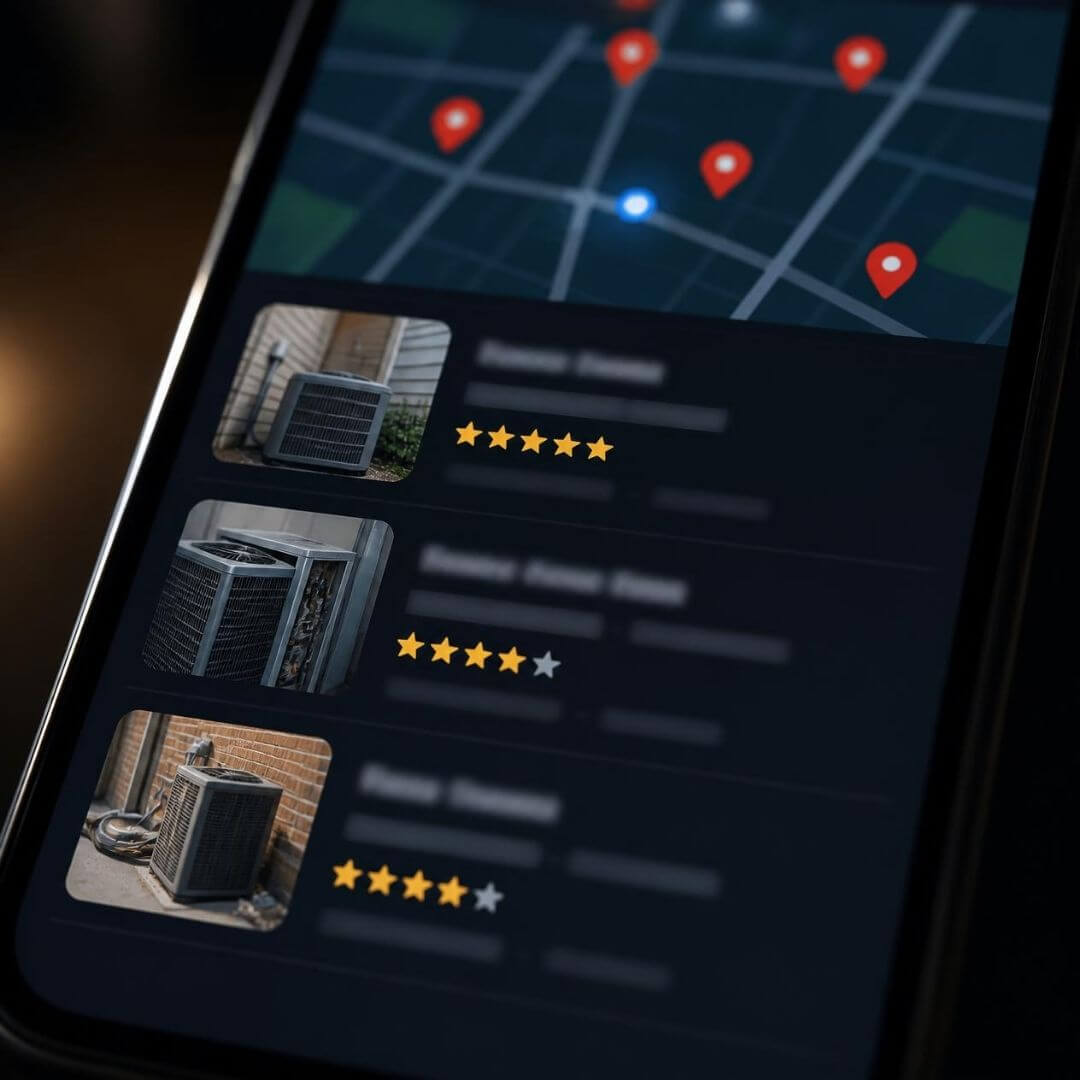
The Google Business Profile is the most important local SEO asset an HVAC company has. It controls map pack ranking, knowledge panel appearance, review display, and visibility in “near me” and city-specific searches. Most HVAC companies set up their GBP once and never return to it. The companies consistently appearing in the top three map pack positions treat it as an active marketing channel — updated weekly, seasonally adjusted, and actively managed year-round.
Complete GBP Optimization for HVAC Companies
- Primary category — “HVAC Contractor” as the primary category. Secondary categories should include “Air Conditioning Contractor” and “Heating Contractor” to capture both season-specific searches.
- Service area — every city, township, and zip code in your actual service footprint. HVAC searches are intensely local — a homeowner in a neighboring city won’t call you if you’re not listed as serving their area.
- Services list — each service listed individually and specifically: AC repair, AC installation, AC maintenance, furnace repair, furnace installation, furnace tune-up, heat pump installation, heat pump repair, air quality testing, duct cleaning, emergency HVAC service. The more specific, the stronger the relevance signal for specific searches.
- Hours — complete and accurate, including emergency availability. “Available 24/7 for emergency service” in your description and your hours setting is a direct conversion signal for the homeowner whose AC failed at 10 PM.
- Description — 750 characters covering your primary services, service area cities, and availability. Include both “air conditioning” and “heating” and “furnace” to ensure relevance across both seasons.
- Phone number — the number that gets answered, or that routes to emergency dispatch. An HVAC company whose phone goes to voicemail during a July heat wave loses the lead within seconds to the next result.
Seasonal GBP Management
The most underutilized GBP tactic for HVAC companies is seasonal content adjustment. Your Google Posts, Q&A content, and service highlights should shift with the season — the same way your actual service offerings shift.
- May through September — Google Posts about AC tune-ups, cooling efficiency, air quality, and emergency AC service. Q&A content addressing summer cooling questions. Photos from AC installation and repair jobs.
- October through April — Google Posts about furnace tune-ups, heating efficiency, heat pump performance in cold weather, and emergency heating service. Q&A content addressing heating questions. Photos from furnace installation and repair jobs.
- Year-round — Respond to every review within 48 hours. Add new job photos monthly. Post weekly regardless of season.
HVAC Local SEO Seasonal Keyword Strategy: Cooling and Heating
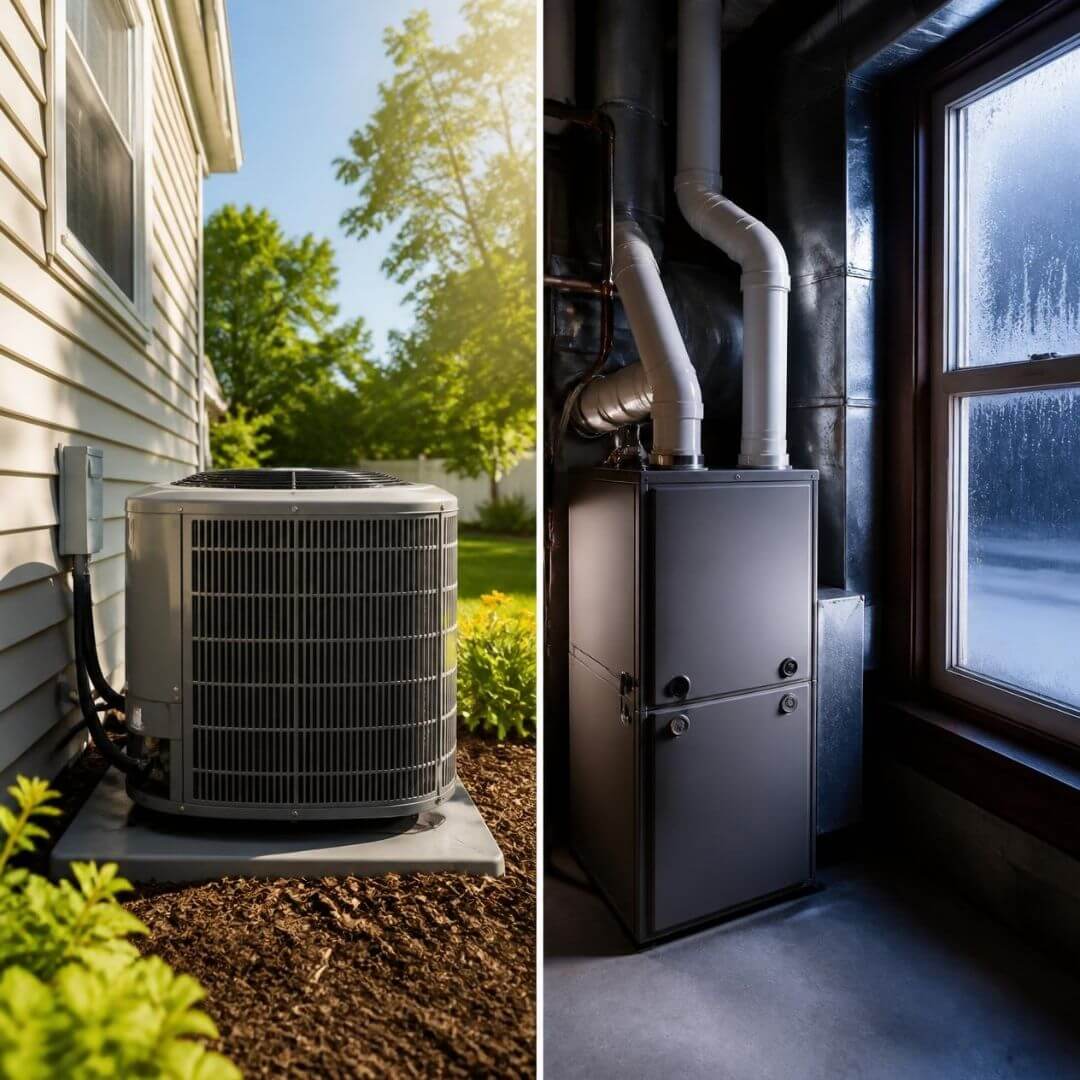
HVAC keyword strategy has a seasonal dimension that most other trades verticals don’t. The searches that drive leads in July are completely different from the searches that drive leads in January — and the HVAC companies ranking for both consistently outperform those optimizing for only one season.
Cooling Season (May–Sep)
- “AC repair [city]”
- “Air conditioning repair near me”
- “AC not working [city]”
- “AC installation [city]”
- “Central air conditioning [city]”
- “AC tune-up [city]”
- “Emergency AC repair [city]”
- “AC company near me”
Heating Season (Oct–Apr)
- “Furnace repair [city]”
- “Furnace not working [city]”
- “Furnace installation [city]”
- “Furnace tune-up [city]”
- “Heating repair near me”
- “Heat pump repair [city]”
- “Emergency furnace repair [city]”
- “Heating company near me”
The Seasonal Timing Opportunity
Most HVAC companies pivot their keyword strategy reactively — they start publishing furnace content when heating calls start coming in. By then, competitors who started publishing in September already have two months of organic authority built. Content published in September for “furnace tune-up [city]” has time to rank before heating searches peak in November and December. Content published in November is starting from zero at exactly the wrong moment.
The rule of thumb: publish next-season content 60-90 days before that season’s search volume peaks. September is when you publish heating content. March is when you publish cooling content. The ranking authority builds while competitors are still thinking about last season.
HVAC Local SEO: Service-Type Location Pages
The most consistently underutilized HVAC local SEO opportunity is service-type location pages. Most HVAC companies have one “HVAC contractor” page or a generic services page. That page ranks poorly for the specific searches that produce the highest-value leads.
“AC repair Cherry Hill NJ” and “furnace installation Camden County” are different searches from different homeowners with different urgency levels and different job values. A single generic HVAC page competes for both poorly. Dedicated pages for each service type in each city consistently outperform catch-all pages in both rankings and conversion rate.
Priority Service Pages to Build
Cooling Service Pages (by city/county):
- “AC repair [city]” — emergency repair, highest urgency, highest conversion rate
- “AC installation [city]” — higher ticket, longer decision timeline
- “Central air conditioning [city]” — captures homeowners researching full system installation
- “AC tune-up [city]” — maintenance segment, recurring revenue opportunity
Heating Service Pages (by city/county):
- “Furnace repair [city]” — emergency repair, highest urgency in heating season
- “Furnace installation [city]” — high-ticket replacement, longer decision timeline
- “Furnace tune-up [city]” — pre-season maintenance, best published in September
- “Heat pump installation [city]” — growing search category as heat pump adoption increases
What Each Page Needs:
- H1 that exactly matches the target keyword: “AC Repair Cherry Hill NJ”
- Opening paragraph that acknowledges the homeowner’s situation — the failed system, the discomfort, the urgency
- Service-specific content: what the repair/installation process looks like, how quickly you can respond, any relevant warranties or guarantees
- Local specifics: mention the city or county, reference local service area
- Tap-to-call phone number prominent above the fold
- Simple contact form — name, phone, brief description of the issue
HVAC Local SEO: Review Generation Year-Round

Google reviews are a direct local ranking signal and the primary trust factor for homeowners comparing HVAC companies in the map pack. A company with 80 reviews at 4.8 stars consistently beats one with 15 reviews at 5.0 stars in both rankings and conversion rate. Volume signals active business. Recency signals active practice.
HVAC companies have a natural review generation advantage that legal practices don’t: there’s no privacy concern. A homeowner who had their AC fixed is happy to say so publicly. The challenge is that most HVAC companies don’t have a systematic process for asking — they rely on satisfied customers to voluntarily leave reviews, which produces a trickle when a system could produce a consistent flow.
A Systematic HVAC Review Generation Process
- Technician verbal request at job completion — “If you’re happy with the work today, we’d really appreciate a Google review. It helps a lot.” This is the highest-converting step and the most consistently skipped.
- Automated SMS sent within 24 hours of job close — direct link to your Google review page, short message: “Thanks for choosing [Company Name]. If you have a moment, we’d love a Google review.” Keep it brief. A single tap to the review link.
- Email follow-up 48 hours later for non-responders — one additional touchpoint, not a campaign. Many customers who didn’t click the SMS will click the email.
- Respond to every review within 48 hours — positive and negative. Your response to a negative review is read by every prospective customer who sees it. A professional, solution-focused response demonstrates accountability and actually converts skeptical prospects.
Fewer clicks produced 170% more leads for a trades client we manage over 11 years of consistent optimization — from 0.025 leads per click to 0.189 leads per click. The same compounding efficiency applies to local SEO: consistent year-round investment produces exponentially better results than seasonal bursts. Full case study →
HVAC Local SEO: NAP Consistency and Directory Strategy
NAP consistency is a foundational HVAC local SEO requirement. Your Name, Address, and Phone number must be identical across your website, GBP, and every directory where your company appears. A single digit difference in a phone number or a street abbreviation inconsistency creates a local SEO signal conflict that suppresses rankings. Run a NAP audit annually at minimum.
Priority Directories for HVAC Companies
- Google Business Profile — the most important directory, already covered above
- Yelp — high consumer traffic for home services. Complete profile with heating and cooling services listed separately.
- Angi (formerly Angie’s List) — significant search authority for HVAC searches and a direct lead source
- HomeAdvisor — similar to Angi, worth maintaining even if you don’t actively use it for leads
- Houzz — growing authority for home improvement and HVAC searches
- Better Business Bureau — trust signal for homeowners making high-ticket decisions like system replacement
- ACCA member directory — the Air Conditioning Contractors of America directory carries industry credibility and some SEO value
- Local chamber of commerce — local citation signal with good geographic relevance
The HVAC Local SEO Off-Season Play Most Companies Miss
Every fall, most HVAC companies do the same thing: the phones slow down, the marketing budget gets cut, the Google Posts stop, and the company essentially goes quiet online. Then every competitor that stayed active picks up the organic ranking positions they spent the summer building.
As covered in our HVAC digital marketing guide, the off-season is when next summer’s competitive advantage gets built — not when you wait for spring.
What Active Off-Season Local SEO Looks Like
- Weekly Google Posts continue without interruption — shift from cooling to heating content in September, but never stop posting. Each post is a freshness signal to Google’s local algorithm. A GBP that goes quiet for three months loses ranking ground to one that stays active.
- Review generation continues year-round — the review system doesn’t pause because call volume drops. Every heating job completed in November should trigger the same review request process as every cooling job completed in July. The homeowner who hires you for a furnace tune-up in October and leaves a review in November is building the review velocity that wins cooling season comparisons in April.
- Heating content published in September and October — furnace tune-up guides, “signs your furnace needs replacement,” heat pump efficiency content, heating system comparison guides. This content has 60-90 days to build authority before heating search volume peaks.
- Maintenance agreement email campaigns to past cooling customers — the homeowner who called you for AC service in July hasn’t thought about their furnace yet. A September email offering a pre-winter furnace inspection at a preferred customer rate converts at high rates because the relationship already exists.
HVAC Local SEO vs. Google Ads: Running Both
The local SEO vs. Google Ads question for HVAC companies has the same answer as every other trades vertical we manage: both, run in parallel — with seasonal budget adjustment that reflects demand patterns rather than going dark entirely.
Local SEO builds compounding map pack visibility that delivers leads without a cost-per-click. Google Ads delivers immediate lead flow and can be activated quickly for emergency surge periods. The two channels reinforce each other — a strong organic presence improves Quality Scores in paid search, and consistent paid search activity maintains account learning that makes seasonal relaunches more efficient.
The compounding efficiency pattern is documented in our Google Ads optimization case study — 64% fewer clicks producing 170% more leads over 11 years of consistent management. For a complete overview of our HVAC company digital marketing approach, visit our full strategy guide. Local SEO produces the same compounding pattern on the organic side: consistent investment builds an authority position that gets harder for competitors to displace over time.
HVAC Local SEO Implementation Roadmap
Phase 1: Foundation (Month 1–2)
- Google Business Profile complete audit — both heating and cooling services listed individually, service area complete, emergency availability noted
- NAP consistency audit across all directories — fix every inconsistency
- Review generation process launch — technician verbal request + automated SMS within 24 hours
- Website mobile speed and conversion audit — tap-to-call prominent, emergency availability visible
- Competitor local SEO gap analysis — identify which service-type pages competitors have that you don’t
Phase 2: Content and Pages (Month 2–5)
- Service-type location page build-out — start with highest-value services (AC repair, furnace repair) in primary service cities
- Seasonal content calendar — plan heating content for September publication, cooling content for March publication
- Weekly Google Posts cadence established and seasonally adjusted
- Trades directory audit and profile completion — Yelp, Angi, HomeAdvisor, BBB, ACCA at minimum
- Google Ads launched in parallel for immediate lead flow
Phase 3: Optimization and Scaling (Month 5–12)
- Map pack ranking monitoring — track AC repair and furnace repair keywords by city monthly
- Review velocity tracking — target minimum 4-6 new reviews per month year-round
- Seasonal content execution — publish on schedule regardless of current call volume
- Service page expansion — add pages for additional service types and additional cities
- Quarterly NAP and GBP audit
- Conversion rate tracking on service-type location pages
Frequently Asked Questions About HVAC Local SEO
Why is local SEO important for HVAC companies?
HVAC searches are overwhelmingly local and overwhelmingly urgent. When a homeowner’s AC fails in July or furnace stops working in January, they search “HVAC repair near me” and call the first credible result in the map pack. HVAC companies that dominate the local map pack consistently capture more emergency leads at lower cost than those relying solely on paid search — and the map pack delivers leads year-round, including in the off-season when competition for positions is lowest.
What are the most important local SEO factors for HVAC companies?
The three most important factors are: Google Business Profile completeness and activity — both heating and cooling services listed separately, regular photos, and weekly Google Posts that shift with the season; review volume and recency — consistent new reviews year-round; and service-type location pages — dedicated pages for AC repair, furnace installation, and other specific services in each city you serve.
How do HVAC companies maintain local SEO rankings in the off-season?
Consistent activity even when call volume drops. Weekly Google Posts continue with heating-focused content. Review generation runs year-round through automated post-job SMS. Heating content is published in September — 60-90 days before demand peaks — to build authority before the season. HVAC companies that maintain consistent GBP activity through winter hold the positions their competitors abandon and launch spring season from a position of strength.
Should HVAC companies have separate pages for heating and cooling services?
Yes — and separate pages for each specific service type within heating and cooling. “AC repair [city]” and “furnace installation [city]” are different searches from different homeowners. A single generic HVAC page competes for all of them poorly. Dedicated service-type location pages rank for the specific search and convert more efficiently than a catch-all page.
How many Google reviews does an HVAC company need to rank in the map pack?
Competitive HVAC markets typically require 40-80 reviews with a rating above 4.7 stars to rank consistently in the top three positions. More important than total count is review velocity — an HVAC company receiving 4-6 new reviews per month will typically outperform one with a larger static count that stopped receiving new reviews six months ago. An automated post-job SMS review request is the most reliable way to build consistent velocity.
What Marketing Practicality delivers for HVAC local SEO:
- Google Business Profile optimization covering both heating and cooling seasons
- Service-type location pages for AC repair, furnace repair, installation, and tune-up by city
- Seasonal content published on the right schedule — not after demand peaks
- Review generation systems that build consistent velocity year-round
- Google Ads campaigns running in parallel for immediate lead flow
- Transparent reporting connecting every marketing activity to leads and cost per lead
Also see our free HVAC digital marketing checklist — a complete audit tool covering Google Ads, local SEO, seasonal strategy, and lead tracking.
The Rankings You Hold in November Win You June
The HVAC companies that dominate their markets in peak season didn’t build their local SEO presence in May. They maintained it through October, November, December, and January — when their competitors went quiet and map pack positions were there for the taking.
The practical starting point is your Google Business Profile. Audit it today. List every service — AC repair, furnace installation, heat pump service — individually and specifically. Add your full service area. Set up a review request process that runs automatically after every job. Start posting weekly. Then keep posting through the slow season.
The rankings you hold in November are the ones your competitors can’t take from you in June.
Get a Free HVAC Local SEO Analysis
Share your website and we’ll show you exactly where your map pack opportunities are — which service pages are missing, where your GBP has gaps, and what your review velocity looks like versus local competitors.
Ready to dominate your local HVAC market year-round?
Get a free website and local SEO analysis — we’ll show you exactly where your biggest map pack opportunities are across both heating and cooling seasons.
Schedule Your Free Strategy SessionFamily Law Google Ads: $83 to $17 CPL in 5 Years
How One Family Law Firm Cut Cost Per Lead from $83 to $17 — and Generated 871 Qualified Leads Five years of Google Ads data…
Bankruptcy Leads: Should You Buy Them or Build Your Own with Google Ads?
Bankruptcy Leads: Should You Buy Them or Build Your Own with Google Ads? A data-driven look at what purchased leads actually cost — and why…
Electrical Contractor Marketing: The Proven Guide
Electrical Contractor Marketing: The Proven System for Growing Your Electrical Business Google Ads, local SEO, and the compounding system behind electrical contractor marketing that generates…