
Bankruptcy Attorney Local SEO: The 2026 Guide
Bankruptcy Attorney Local SEO: How to Get Found When Clients Finally Search
The Google Business Profile, content, and review system that gets bankruptcy firms into the map pack — at the exact moment clients stop avoiding and start searching
A bankruptcy client doesn’t search on a whim. They search after months — sometimes years — of avoidance. They’ve missed payments, negotiated with creditors, drained savings, and told themselves it will turn around. Then one night, usually late, on their personal phone, they finally type “bankruptcy attorney near me.”
I’m Duncan Lauder, President of Marketing Practicality, and I’ve managed digital marketing for bankruptcy attorneys for over 25 years. Bankruptcy attorney local SEO has a specific characteristic that sets it apart from most legal verticals: the client’s decision to search is itself a major psychological event. By the time they type that query, they’ve already decided they need help. They’re just deciding who. The firm that appears first in the map pack with the right signals wins that decision — usually within minutes of the search.
This guide covers the complete local SEO system for bankruptcy attorneys — Google Business Profile optimization, Chapter 7 and Chapter 13 location pages, privacy-aware review generation, and the content strategy that captures clients at every stage of the consideration window.

Table of Contents
- The Search Psychology: Why Local SEO Matters More in Bankruptcy
- Google Business Profile Optimization for Bankruptcy Attorneys
- Chapter 7 and Chapter 13 Location Pages
- Content Strategy: Capturing the Consideration Window
- Review Generation: Overcoming the Privacy Challenge
- NAP Consistency and Legal Directory Strategy
- Seasonal Patterns in Bankruptcy Searches
- Local SEO vs. Google Ads: Running Both
- Implementation Roadmap
- Frequently Asked Questions
The Search Psychology: Why Local SEO Matters More in Bankruptcy

Understanding how bankruptcy clients search is essential to building a local SEO system that captures them. The psychology is distinct — and it directly shapes which tactics matter most.
As covered in our bankruptcy law digital marketing post, the bankruptcy client’s journey looks nothing like a consumer making a considered purchase decision. It looks like this:
- Months of avoidance — telling themselves it will improve
- Increasing creditor pressure — calls, letters, garnishment notices
- A breaking point — usually a specific event that makes the problem impossible to ignore
- A private, late-night search — on their personal phone, hoping nobody sees
- A fast decision — once they decide to act, they move quickly
Three things follow from this psychology for local SEO specifically:
Organic search matters more than referrals. A bankruptcy client is not calling friends and family for attorney referrals. The shame of the situation makes that impossible for most people. They’re searching privately — which means organic search and map pack visibility are the primary discovery channels, not word of mouth.
The map pack captures the decision. When someone finally searches “bankruptcy attorney near me” at 11 PM, they click one of the three map pack listings, read reviews for about a minute, and call. The consideration phase is short. The three firms in the map pack get the calls. Everyone below the map rarely gets a call at all.
Trust signals need to be immediate. A bankruptcy client comparing two map pack listings needs to feel that your firm is credible and safe to contact within seconds of landing on your profile. Review count, rating, and recency are the primary trust signals. A profile with consistent recent reviews converts significantly better than one with a static count from years ago.
Google Business Profile Optimization for Bankruptcy Attorneys
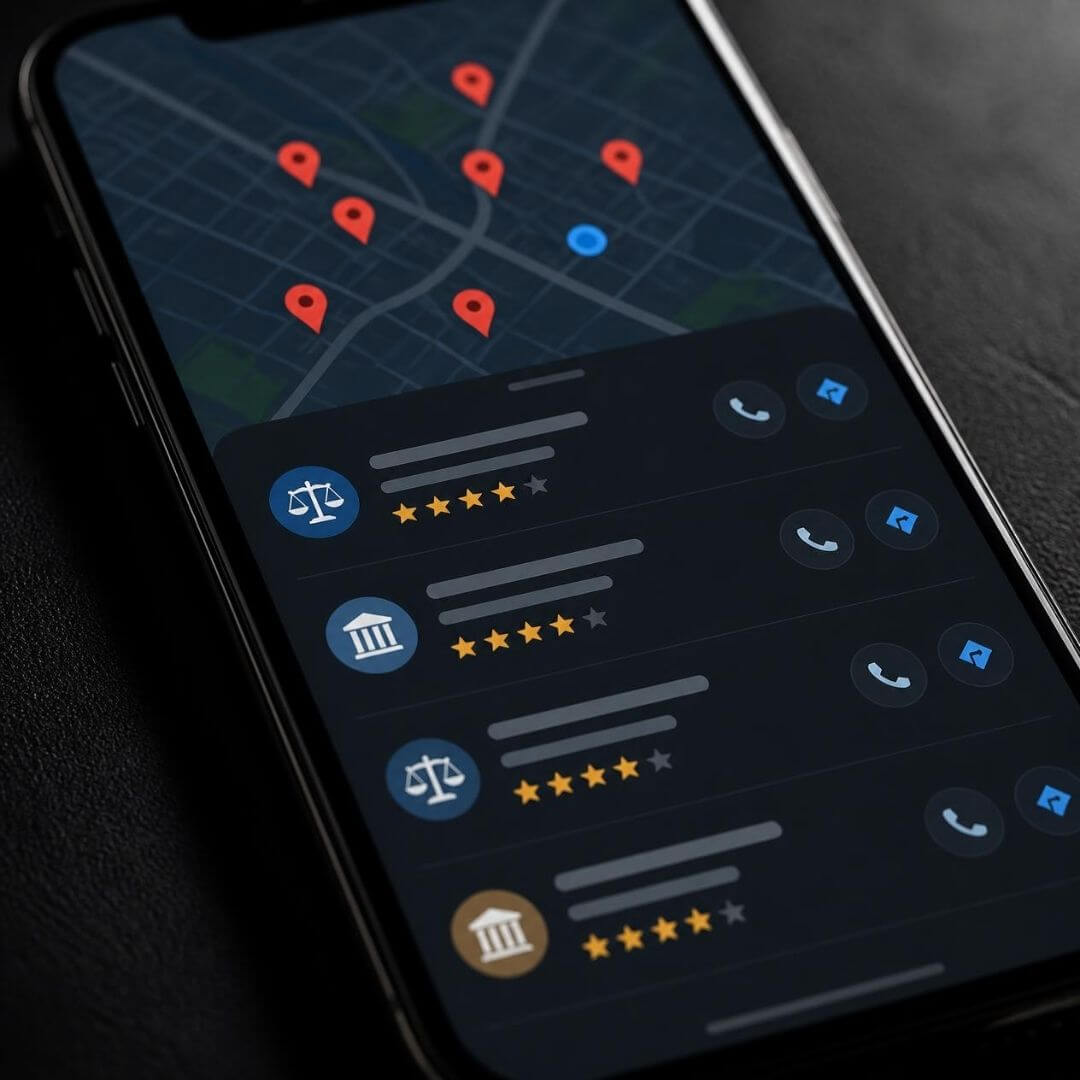
The Google Business Profile is the foundation of bankruptcy local SEO. It controls map pack ranking, knowledge panel appearance, review display, and visibility in “near me” searches. Most bankruptcy attorneys complete a basic profile setup and never return to it. The firms consistently ranking in the top three treat it as an active marketing asset.
Complete GBP Optimization for Bankruptcy Law
- Primary category — “Bankruptcy Attorney” as the primary category. This is the single most important GBP field for map pack ranking in this vertical.
- Service area — every city, county, and township you actually serve, not just your office location. Bankruptcy clients search from their home location, not your office location.
- Services list — each service listed individually: Chapter 7 bankruptcy, Chapter 13 bankruptcy, debt relief, creditor harassment defense, wage garnishment defense, foreclosure defense, bankruptcy exemptions counseling. The more specific the service list, the stronger the relevance signal for specific searches.
- Hours — complete and accurate. If you offer evening consultations — and you should, given when bankruptcy clients search — list them explicitly.
- Description — 750 characters that include “Chapter 7,” “Chapter 13,” your primary city or county, and language that addresses the emotional state of your searcher: “confidential consultation,” “stop creditor calls,” “protect your home.”
- Phone number — the number that gets answered, or that has a same-day callback process. A bankruptcy client who leaves a voicemail at 10 PM and hears back the next afternoon has already called two other firms.
Active GBP Management
- Weekly Google Posts — short posts about Chapter 7 vs. Chapter 13, recent changes in bankruptcy law, creditor harassment rights, or the bankruptcy process. Each post signals active practice to Google’s local algorithm.
- Q&A section populated proactively — “Will bankruptcy stop creditor calls?” “Can I keep my house if I file bankruptcy?” “What’s the difference between Chapter 7 and Chapter 13?” Answer these yourself before prospects ask.
- Photos updated regularly — your office, your team (with permission), any professional recognitions. Real photos consistently outperform stock imagery for both rankings and conversion.
Chapter 7 and Chapter 13 Location Pages
The most underutilized local SEO opportunity in bankruptcy law is chapter-specific location pages. Most bankruptcy firms have one “bankruptcy attorney” page. That page ranks poorly for the specific searches that convert best.
“Chapter 7 bankruptcy attorney [city]” and “Chapter 13 attorney [county]” are different searches from people in different financial situations. Someone searching Chapter 7 is typically looking at liquidation — they want to understand whether they qualify, what assets they can keep, and how quickly the process works. Someone searching Chapter 13 is often a homeowner trying to stop foreclosure or a person with regular income who wants a repayment plan. Same practice area, different client, different content needed.
The Page Structure
Chapter 7 Bankruptcy Attorney [City] pages:
- H1 that exactly matches the target keyword
- Opening paragraph addressing the emotional state — financial stress, creditor pressure, the desire for a fresh start
- Chapter 7-specific content: means test explanation, exemptions for your state, the timeline, what happens to different asset types
- Local court specifics: your bankruptcy district, local trustee procedures, typical hearing timelines
- Internal links to the case study, the checklist, and the Chapter 13 page
- Empathy-first CTA: “Stop creditor calls — free confidential consultation”
Chapter 13 Bankruptcy Attorney [City] pages:
- Same structure with Chapter 13-specific content: repayment plan process, how it stops foreclosure, how it handles car loans and other secured debt
- Emphasize the protection benefits — Chapter 13 clients are often trying to save something specific (home, car, retirement) rather than simply discharge debt
- Local court and trustee specifics for your district
Additional location pages worth building:
“Stop creditor calls attorney [city]” — captures searches from people being harassed by creditors who haven’t yet decided on bankruptcy. “Wage garnishment attorney [city]” — a high-urgency search from people whose paycheck is already being garnished. “Bankruptcy exemptions [state]” — a research-phase search from people evaluating whether bankruptcy makes sense for their specific assets. Each of these captures a segment of the bankruptcy audience that a generic bankruptcy attorney page misses.
Content Strategy: Capturing the Consideration Window

Bankruptcy clients spend months in a consideration window before they call. During that window they search repeatedly — researching their options, reading about the process, trying to understand whether bankruptcy is right for their situation. The firm whose content answers those research questions becomes the familiar name when the client finally decides to act.
High-Value Content Categories
Urgency-Phase Keywords (highest conversion intent):
- “Bankruptcy attorney near me”
- “File bankruptcy [city]”
- “Stop creditor calls attorney [city]”
- “Wage garnishment attorney [city]”
- “Foreclosure defense attorney [city]”
Research-Phase Keywords (lower conversion, builds authority):
- “How does Chapter 7 bankruptcy work in [state]”
- “Chapter 7 vs Chapter 13 bankruptcy [state]”
- “Will bankruptcy stop wage garnishment [state]”
- “Can I keep my house if I file bankruptcy [state]”
- “Bankruptcy means test [state]”
- “How long does bankruptcy stay on your credit”
Research-phase content matters more in bankruptcy than in most legal verticals precisely because the consideration window is so long. A blog post that answers “will bankruptcy stop creditor calls in New Jersey” ranks for a search that happens months before the client is ready to hire — but it establishes your firm as the authority who answered their question when they needed it. That familiarity converts when the crisis finally peaks.
Review Generation: Overcoming the Privacy Challenge

Google reviews are a direct local ranking signal and the primary trust factor for bankruptcy prospects comparing firms in the map pack. The challenge in bankruptcy is the same as in family law and professional license defense: clients are often reluctant to publicize that they filed for bankruptcy.
The solution is a review request process that separates the review from the case details.
A Bankruptcy Review Generation System
- Attorney verbal request at case discharge — “If you’re comfortable, a Google review from you helps others in similar situations find us. You don’t need to mention financial details — just your experience working with our team.”
- Automated SMS within 24 hours of discharge — direct link to Google review page, brief message: “Thank you for trusting us with your case. If you’re willing to share your experience, here’s a quick link to our Google reviews.”
- Email follow-up 48 hours later for non-responders — one additional touchpoint with the reassurance that the review doesn’t need to mention financial details.
- Respond to every review within 48 hours — positive and negative. Bankruptcy clients reading reviews are particularly attuned to how the attorney treats past clients. A professional, empathetic response to a negative review converts skeptical prospects better than a perfect rating with no responses.
Cost per lead reduction for a New Jersey bankruptcy attorney over 15 years — from $239 per lead in 2015 to $21 per lead in 2024. 1,030 conversions in 2024. Consistent local SEO and paid search optimization compounded over time. Full case study →
NAP Consistency and Legal Directory Strategy
Your Name, Address, and Phone number must be identical across every platform where your firm appears — your website, GBP, Avvo, FindLaw, Justia, Martindale-Hubbell, the state bar directory, and every bankruptcy-specific directory. A single inconsistency creates a local SEO signal conflict that suppresses rankings.
Priority Directories for Bankruptcy Attorneys
- Avvo — high domain authority, frequently appears in bankruptcy searches. Complete your profile with Chapter 7 and Chapter 13 listed as specific practice areas.
- FindLaw — strong authority for bankruptcy-related searches. Include your chapter-specific services in the profile.
- Justia — free, high-authority legal directory. Bankruptcy profile with specific chapter focus outperforms generic bankruptcy listing.
- NACBA directory — the National Association of Consumer Bankruptcy Attorneys maintains a member directory that carries both referral and SEO value for bankruptcy-specific searches.
- State bar directory — always match your GBP exactly for name, address, and phone format.
Seasonal Patterns in Bankruptcy Searches
Bankruptcy search volume follows a consistent seasonal pattern that creates predictable local SEO opportunities:
- January — the highest bankruptcy filing month of the year. Holiday spending, year-end financial reckoning, and the psychological reset of a new year all combine to produce peak bankruptcy search volume. Content published in October and November — “how to file bankruptcy in [state] in 2027,” “Chapter 7 bankruptcy process in [county]” — builds organic authority before January peaks.
- February through April — elevated volume as January filers refer others and tax season surfaces financial realities. Tax refund decisions (“should I use my tax refund to pay debt or file bankruptcy”) produce a distinct search category worth targeting.
- Summer — lower volume but not zero. Maintain consistent GBP activity and content production through the slower months to hold ranking positions competitors are abandoning.
- October through December — volume builds again as year-end financial pressure increases and clients begin researching before the January decision point.
The practical implication: bankruptcy local SEO is a year-round investment, not a seasonal push. The firms ranking in January are the ones who maintained consistent activity in July.
Local SEO vs. Google Ads: Running Both
The question of local SEO versus Google Ads for bankruptcy attorneys has the same answer as every other legal vertical we manage: both, run in parallel.
Local SEO builds compounding organic visibility. Google Ads delivers immediate lead flow. The combination is more powerful than either channel alone — and the documented result across 15 years of bankruptcy campaign management is a 91% cost per lead reduction. Local SEO contributed to that trajectory by reducing the cost of organic leads over time and improving the overall Quality Score environment that made paid search more efficient.
For the full paid search strategy — campaign structure, ad copy, bidding, and the documented CPL trajectory — see our bankruptcy law digital marketing post and bankruptcy case study. For a complete overview of our bankruptcy attorney marketing services, visit our service page.
Implementation Roadmap for Bankruptcy Attorney Local SEO
Phase 1: Foundation (Month 1–2)
- Google Business Profile complete audit — Chapter 7, Chapter 13, and debt relief services listed individually
- NAP consistency audit across all directories — fix every inconsistency
- Q&A section populated with the top 5-8 bankruptcy questions for your state
- Review generation process launch — verbal request at discharge + automated SMS
- Website mobile speed and conversion audit — tap-to-call, simple form, empathy-first copy
Phase 2: Content and Pages (Month 2–5)
- Chapter 7 location pages — primary cities and counties in service area
- Chapter 13 location pages — same geographic footprint
- Research-phase content — Chapter 7 vs Chapter 13 guide, means test explainer, exemptions guide for your state
- Weekly Google Posts cadence established
- Legal directory audit — Avvo, FindLaw, Justia, NACBA, state bar
- Google Ads launched in parallel for immediate lead flow
Phase 3: Optimization and Scaling (Month 5–12)
- Map pack ranking monitoring — track Chapter 7 and Chapter 13 keywords by city monthly
- Review velocity tracking — target minimum 2-3 new reviews per month
- Seasonal content — October/November content for January filing spike
- Content expansion — additional location pages, additional research-phase topics
- Quarterly NAP and GBP audit
- Conversion rate tracking on chapter-specific location pages
Frequently Asked Questions About Bankruptcy Attorney Local SEO
Why is local SEO important for bankruptcy attorneys?
Bankruptcy clients almost always search locally — and they search privately, after months of avoidance. When someone finally searches “bankruptcy attorney near me” at 11 PM, the three firms in the Google map pack get the calls. Bankruptcy firms that dominate the local map pack consistently generate leads at significantly lower cost than those relying solely on paid search.
What keywords should bankruptcy attorneys target for local SEO?
High-converting keywords combine chapter type, location, and urgency: “Chapter 7 bankruptcy attorney [city],” “Chapter 13 attorney [county],” “bankruptcy lawyer near me,” “stop creditor calls attorney [city].” Research-phase keywords — “how does Chapter 7 work in [state],” “will bankruptcy stop wage garnishment” — capture clients earlier in the consideration window and build organic authority that converts when they are ready to hire.
How long does local SEO take for bankruptcy law firms?
Google Business Profile optimization typically shows ranking movement within 60-90 days. Full map pack rankings for competitive bankruptcy keywords take 6-12 months. The compounding effect is significant — a bankruptcy attorney we manage went from $239 per lead in 2015 to $21 per lead in 2024, a 91% reduction, through consistent local SEO and Google Ads optimization over 15 years.
How do you generate Google reviews for a bankruptcy attorney?
Request reviews at case discharge framed around the experience of working with your team, not the financial details. Follow with an automated SMS containing a direct link to your Google review page. Respond to every review within 48 hours. Review velocity matters more than total count for local ranking purposes.
Should bankruptcy attorneys have separate pages for Chapter 7 and Chapter 13?
Yes. “Chapter 7 bankruptcy attorney [city]” and “Chapter 13 attorney [city]” are different searches from people in different financial situations. A single generic bankruptcy page competes for both poorly. Dedicated location-specific pages for each chapter — addressing the specific client situation, local court procedures, and local trustee requirements — rank for the specific search and convert more efficiently.
What Marketing Practicality delivers for bankruptcy attorney local SEO:
- Google Business Profile optimization that moves map pack rankings within 60-90 days
- Chapter 7 and Chapter 13 location pages for every significant city in your service area
- Research-phase content that captures clients during the months-long consideration window
- Privacy-aware review generation systems that build consistent velocity
- Seasonal content strategy timed to January and spring filing spikes
- Transparent reporting connecting every marketing activity to leads and cost per lead

The Search Is Coming. Be There When It Does.
The bankruptcy client who will call your firm in January is searching right now. Not for an attorney yet — for information. For answers. For reassurance that there’s a path forward. The firms that show up consistently during that research phase — in the map pack, in organic results, in the Q&A on their GBP — become the familiar name when the client finally decides to call.
The practical starting point is your Google Business Profile. Audit it today. Add Chapter 7 and Chapter 13 as specific services. Add every city and county in your service area. Set up a review request process. Start posting weekly. That single asset, actively maintained, moves the needle faster than any other local SEO action available to a bankruptcy attorney.
Get a Free Bankruptcy Attorney Local SEO Analysis
Share your website and we’ll show you exactly where your map pack opportunities are — which chapter-specific pages are missing, where your GBP has gaps, and what your review velocity looks like versus local competitors.
Ready to dominate your local bankruptcy market?
Get a free website and local SEO analysis — we’ll show you exactly where your biggest map pack opportunities are and what it would take to rank for Chapter 7 and Chapter 13 searches in your area.
Schedule Your Free Strategy SessionFamily Law Google Ads: $83 to $17 CPL in 5 Years
How One Family Law Firm Cut Cost Per Lead from $83 to $17 — and Generated 871 Qualified Leads Five years of Google Ads data…
Bankruptcy Leads: Should You Buy Them or Build Your Own with Google Ads?
Bankruptcy Leads: Should You Buy Them or Build Your Own with Google Ads? A data-driven look at what purchased leads actually cost — and why…
Electrical Contractor Marketing: The Proven Guide
Electrical Contractor Marketing: The Proven System for Growing Your Electrical Business Google Ads, local SEO, and the compounding system behind electrical contractor marketing that generates…