
Plumbing Google Ads: The Proven Guide for Contractors
Plumbing Google Ads: The Proven System for Plumbing Contractors
The campaign structure, emergency ad copy, and seasonal bidding strategy behind plumbing Google Ads campaigns that win emergency calls and planned service leads year-round
Plumbing Google Ads operate on a principle that sets them apart from almost every other trades vertical: the homeowner with a plumbing emergency does not comparison shop. As documented in our post on the 2 AM phone call, when water is coming through the ceiling, the homeowner searches once, calls the first result that answers, and books the job. The plumbing company that wins that call is not necessarily the most experienced or the most affordable — it is simply the one that showed up first in the search results and picked up the phone.
I’m Duncan Lauder, President of Marketing Practicality, and I’ve managed plumbing Google Ads and trades contractor campaigns for over 25 years. The campaign structure, ad copy approach, and seasonal bidding strategy that consistently produces efficient leads for plumbing contractors — in emergency searches and planned service searches alike — is the subject of this post. For the complementary local SEO strategy, see our plumbing local SEO guide.

Table of Contents
- Why Plumbing Google Ads Work Differently
- Plumbing Google Ads Campaign Structure
- Plumbing Google Ads Ad Copy That Converts
- Plumbing Google Ads Landing Pages
- Plumbing Google Ads Negative Keywords
- Plumbing Google Ads Seasonal Strategy
- Plumbing Google Ads Bidding Strategy
- Plumbing Google Ads and the Compounding Effect
- Plumbing Google Ads Implementation Roadmap
- Frequently Asked Questions
Why Plumbing Google Ads Work Differently
Plumbing Google Ads serve two completely different audiences simultaneously — and the most common structural mistake in plumbing campaigns is treating them the same. The emergency audience has an immediate, urgent need and converts on the first search. The planned service audience is researching a significant home expense and will compare options before committing. Each audience requires its own campaign, its own ad copy, and its own landing page.
The Emergency Plumbing Google Ads Audience
Emergency plumbing searches happen at unpredictable times — 2 AM on a Tuesday, Christmas morning, the hour before a dinner party. The homeowner is stressed. They are not reading three contractor websites. They are calling the first plumber who appears in paid search results and answers the phone. Consequently, emergency plumbing Google Ads campaigns need to be running 24 hours a day, 7 days a week, with messaging that signals immediate availability above all else.
Furthermore, emergency plumbing leads have the highest lifetime value in the plumbing customer relationship. A homeowner who calls you for a burst pipe at 2 AM and has a good experience becomes a maintenance customer, a water heater replacement customer, and a referral source. The emergency call is the beginning of a long customer relationship — not just a one-time job.
The Planned Service Plumbing Google Ads Audience
Planned service searches — water heater replacement, drain cleaning, whole-home repiping, water softener installation — come from homeowners who have time to research. They are comparing prices, reading reviews, and evaluating options before calling. As a result, planned service plumbing Google Ads campaigns need different messaging than emergency campaigns. Financing availability, specific service guarantees, and manufacturer certifications convert this audience. Urgency messaging does not.
Plumbing Google Ads vs. local SEO:
This post focuses entirely on paid search. For the complementary local SEO strategy — Google Business Profile optimization, emergency content pages, and map pack rankings — see our plumbing local SEO guide and plumbing company digital marketing guide. Running both channels together consistently outperforms either alone. For a complete audit, use the free plumbing digital marketing checklist.
Plumbing Google Ads Campaign Structure
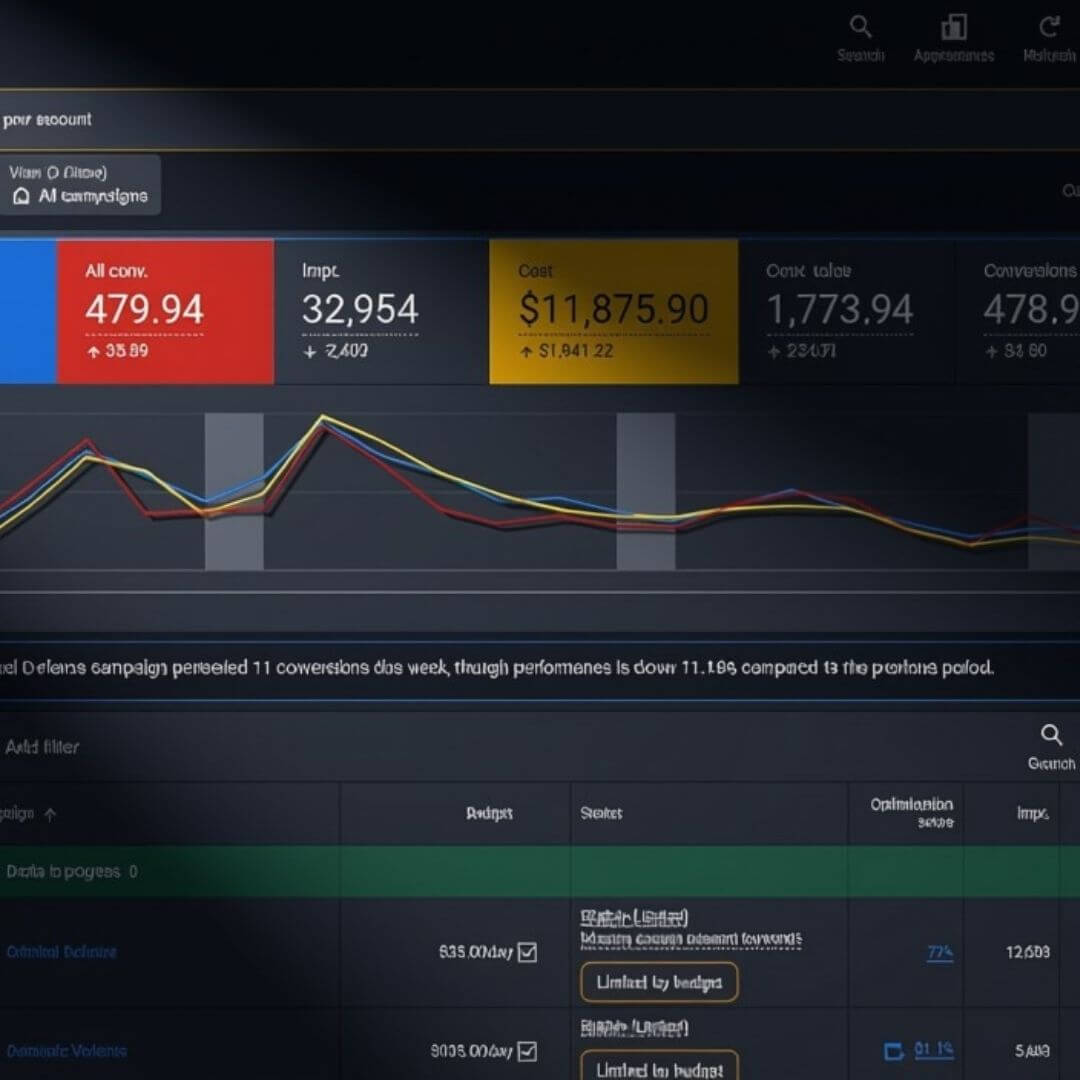
The most important decision in plumbing Google Ads is campaign structure. One broad “plumber near me” campaign competing for emergency calls, water heater replacements, and drain cleaning simultaneously serves none of these audiences efficiently. By contrast, separate campaigns for each service type — each with its own keywords, ad copy, budget allocation, and landing page — consistently outperform catch-all campaigns in both Quality Score and conversion rate.
Plumbing Google Ads Emergency Campaign
The emergency campaign is the most important in the plumbing portfolio. It runs 24 hours a day, 7 days a week, at the highest budget allocation. It has the shortest conversion path of any plumbing campaign — the goal is a phone call, not a form fill. Specifically, the emergency campaign structure includes:
- Emergency plumbing ad group — “emergency plumber near me,” “emergency plumber [city],” “plumber available now,” “plumber open now [county]”
- Burst pipe ad group — “burst pipe repair [city],” “broken pipe emergency,” “pipe burst repair near me” — the highest-urgency subset of emergency plumbing
- No hot water ad group — “no hot water [city],” “water heater not working,” “water heater repair emergency” — high volume, high urgency, bridges emergency and planned service
- Clogged drain emergency ad group — “clogged drain emergency,” “drain backup [city],” “toilet overflowing” — captures drain emergencies before they become larger problems
Plumbing Google Ads Water Heater Campaign
Water heater is the highest-ticket planned service in most plumbing markets — $800 to $3,000+ depending on the system type. Accordingly, it warrants its own campaign rather than being buried in a general planned service campaign. The water heater campaign includes:
- Water heater replacement ad group — “water heater replacement [city],” “new water heater installation [county],” “water heater replacement cost”
- Water heater repair ad group — “water heater repair [city],” “water heater not working,” “fix water heater near me”
- Tankless water heater ad group — “tankless water heater installation [city],” “tankless water heater cost” — a growing category that deserves its own dedicated targeting
Plumbing Google Ads Drain and Sewer Campaign
Drain cleaning is the highest-volume planned service plumbing keyword in most markets. It also has strong seasonal patterns — spring drain cleaning searches spike as homeowners prepare for increased usage. The drain and sewer campaign includes:
- Drain cleaning ad group — “drain cleaning [city],” “drain cleaning near me,” “clogged drain [county]”
- Sewer line ad group — “sewer line repair [city],” “sewer line replacement [county],” “sewer backup plumber”
- Hydro jetting ad group — “hydro jetting [city],” “hydro jet drain cleaning near me” — a specific service that homeowners increasingly search for by name
Plumbing Google Ads Additional Service Campaigns
Beyond the three primary campaigns, additional service-specific campaigns can be added as the account matures and budget allows:
- Leak detection — “water leak detection [city],” “leak detection plumber near me”
- Water softener — “water softener installation [city],” “water softener near me”
- Pipe replacement — “pipe replacement [city],” “repiping [county]”
- Commercial plumbing — a separate audience entirely, requiring its own campaign and landing pages
Plumbing Google Ads Ad Copy That Converts
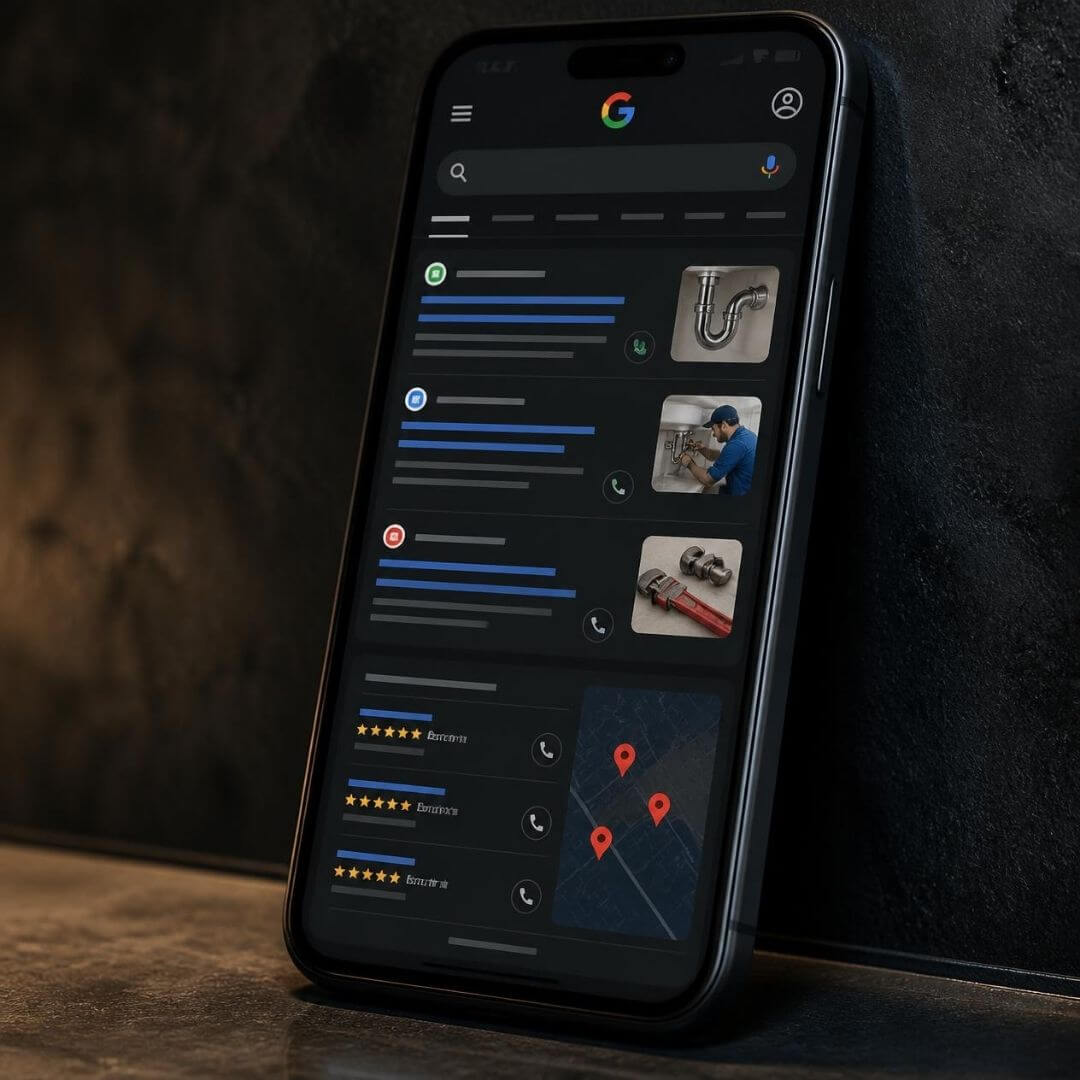
The principle driving effective plumbing Google Ads copy is the same across both emergency and planned service campaigns: match the emotional state of the searcher, not the credentials of the plumber. A homeowner with a burst pipe is not evaluating years of experience. They are evaluating whether you can come right now and fix it.
Plumbing Google Ads Emergency Copy
Plumbing Google Ads Water Heater Copy
Plumbing Google Ads Ad Extension Strategy
- Call extensions — essential for emergency campaigns. The homeowner with a plumbing emergency wants to call, not fill out a form. A call extension connecting directly to a dispatcher during business hours — and to an after-hours line outside them — captures the highest-value leads at the moment of highest intent.
- Location extensions — shows your service area directly in the ad. Particularly important for plumbing where homeowners are filtering for local providers who can respond quickly.
- Sitelink extensions — link to service-specific pages: Emergency Plumbing, Water Heater, Drain Cleaning, Financing. Sitelinks expand your ad footprint and allow the prospect to self-select the most relevant service.
- Callout extensions — “Available 24/7,” “Licensed and Insured,” “Same Day Service,” “Financing Available” — these conversion signals add to every ad without consuming headline space.
- Promotion extensions — seasonal tune-up specials, first-time customer discounts, and financing offers can be promoted directly in the ad during appropriate seasons.
Plumbing Google Ads Landing Pages

The landing page is where plumbing Google Ads campaigns win or lose leads. A well-structured campaign gets the click — the landing page determines whether that click becomes a call. Emergency plumbing landing pages and planned service landing pages have fundamentally different jobs and should be built accordingly.
Plumbing Google Ads Emergency Landing Pages
Emergency landing pages have one job: make it as easy as possible to call right now. Every element on the page should serve that single goal. Specifically:
- Tap-to-call phone number above the fold — the single most important element. On mobile, where the majority of emergency plumbing searches happen, the phone number must be visible without any scrolling. A second prominent call button mid-page adds conversion volume.
- Availability signal in the H1 — “Emergency Plumber [City] — Available 24/7” confirms immediately that the homeowner reached the right place. This is not a tagline. It is a conversion element.
- Response time signal — “Typically arrive within 60 minutes in [county]” is specific and credible. It converts emergency searchers more effectively than generic “fast response” language.
- No navigation menu — every exit path that isn’t a phone call costs conversions. Emergency landing pages should have no navigation menu, no sidebar, and no outbound links beyond the call-to-action.
- Mobile load time under 2.5 seconds — every additional second of load time costs conversions from a stressed homeowner who needs help immediately.
- Three-field contact form as backup — name, phone number, and brief description of the issue. Some homeowners prefer to submit a form rather than call. Both paths should be equally frictionless.
Plumbing Google Ads Planned Service Landing Pages
Planned service landing pages serve a different audience with a longer decision timeline. In addition to the conversion basics — prominent phone number, simple contact form — planned service pages should include financing information prominently, service-specific content addressing the homeowner’s specific concern, and trust signals relevant to a higher-ticket decision: licensing information, manufacturer certifications, warranty details, and real customer reviews.
Why Service-Specific Landing Pages Matter for Plumbing Google Ads
A homeowner who clicked a water heater replacement ad and landed on a generic “plumbing services” page feels an immediate mismatch. They clicked because they needed water heater help. Instead, the page is talking about drain cleaning, emergency plumbing, and pipe repair. As a result, they leave. Dedicated landing pages for each campaign — one for emergency plumbing, one for water heater replacement, one for drain cleaning — eliminate that mismatch entirely and convert at significantly higher rates.
Plumbing Google Ads Negative Keywords
Negative keyword management is one of the highest-leverage ongoing optimizations in plumbing Google Ads. Every irrelevant search that triggers your ad costs money, dilutes your conversion rate, and signals low relevance to Google’s Quality Score algorithm. Review the search terms report monthly and add negatives consistently. The improvement compounds over time.
Plumbing Google Ads Negative Keyword Categories
DIY and Self-Help:
- “How to fix a clogged drain,” “DIY pipe repair,” “plumbing how to,” “unclog drain yourself,” “fix leaky faucet DIY”
Parts and Supplies Only:
- “Plumbing parts,” “pipe fittings,” “water heater parts,” “plumbing supplies near me,” “toilet parts”
Career and Education:
- “Plumber salary,” “plumbing apprenticeship,” “how to become a plumber,” “plumbing school,” “plumbing certification”
Rental and Temporary:
- “Plumbing snake rental,” “drain snake rental,” “auger rental,” “portable water heater rental”
Non-Service Intent:
- “Plumbing code,” “plumbing diagram,” “plumbing permit,” “plumbing inspection requirements”
Plumbing Google Ads Seasonal Strategy
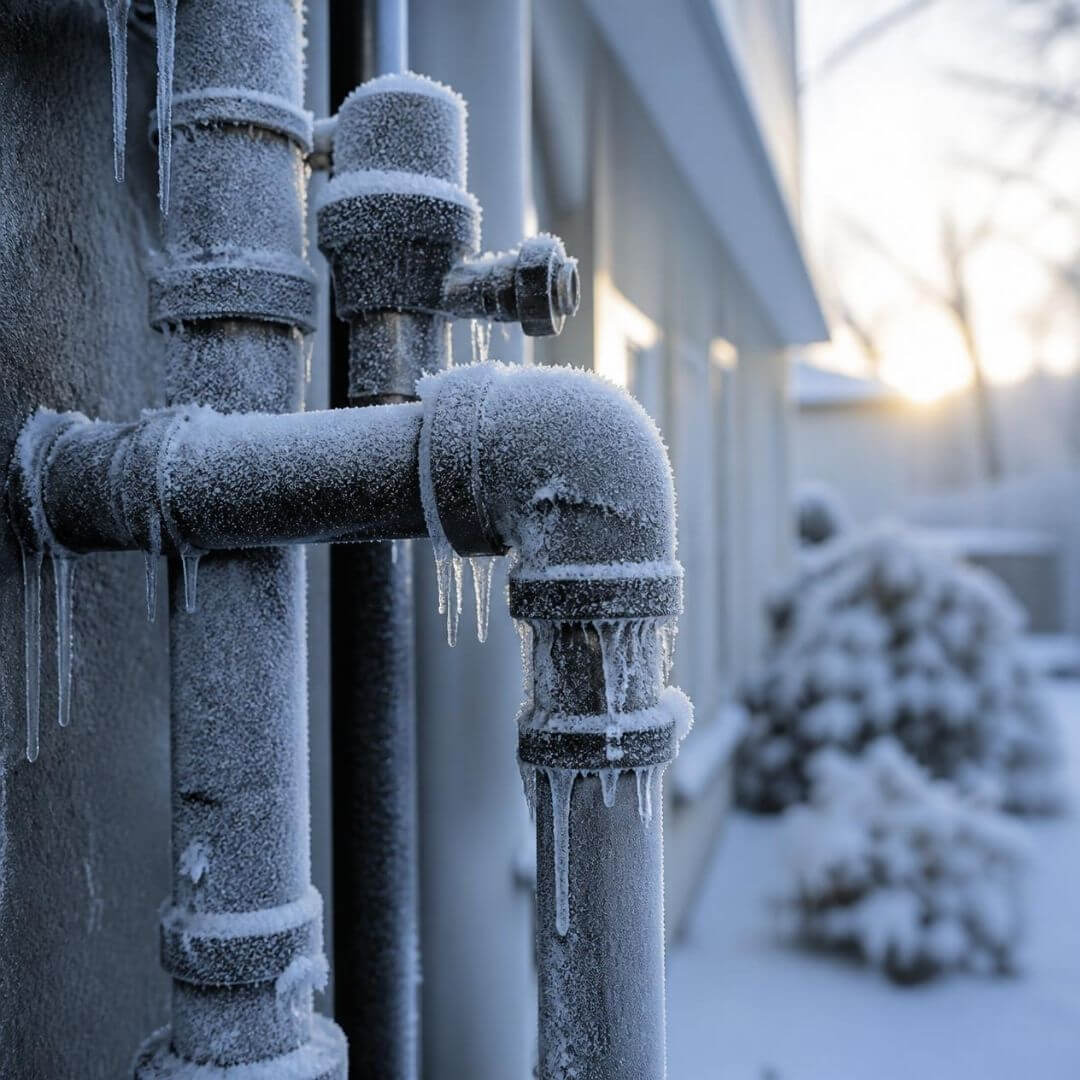
Plumbing has predictable seasonal demand patterns that create consistent campaign adjustment opportunities throughout the year. Unlike HVAC — where demand swings are driven primarily by temperature — plumbing demand is driven by a combination of weather events, home maintenance cycles, and planned renovation activity. Planning seasonal budget and messaging adjustments in advance allows campaigns to capture peak demand from day one rather than scrambling to respond after it arrives.
Plumbing Google Ads Winter Strategy (December–February)
Winter is peak emergency season for plumbing. Pipe freezes, water heater failures in cold weather, and frozen outdoor faucets all spike in January and February. As a result, the emergency campaign should run at its highest annual budget during this period. Specifically, the winter strategy involves:
- Emergency campaign budget at maximum — pipe freeze calls are the highest-urgency and highest-converting leads of the year
- Ad copy updated to include pipe freeze and frozen pipe language — “Frozen Pipes? Available Now — Emergency Service”
- 24/7 call extension active throughout the winter period
- Water heater repair campaign elevated — cold weather increases water heater failures significantly
Plumbing Google Ads Spring Strategy (March–May)
Spring is the peak planned service season. Drain cleaning searches surge as homeowners prepare for increased usage. Sump pump installation peaks ahead of spring flooding. Water heater replacement activity increases as homeowners begin home improvement projects. Moreover, spring is when competition for plumbing keywords increases — campaigns that maintained Quality Score through winter hold position more efficiently than those relaunching from a pause.
Plumbing Google Ads Summer Strategy (June–August)
Summer brings outdoor plumbing work, bathroom renovation projects, and continued water heater replacement activity. Additionally, irrigation system installation and outdoor faucet repairs become relevant. The summer strategy maintains the emergency campaign year-round while increasing budget for renovation-related planned service campaigns.
Plumbing Google Ads Fall Strategy (September–November)
Fall is the pre-winter preparation season. Homeowners search for pipe winterization, outdoor faucet shut-off services, and water heater tune-ups before the cold arrives. Consequently, pre-winter content in ad copy — “Winterize Your Plumbing Before the First Freeze” — converts well in October and November. Building this campaign content in August allows it to be live and optimized before the fall surge begins.
Plumbing Google Ads Bidding Strategy
The right plumbing Google Ads bidding strategy changes as the account matures — early-stage campaigns need manual control, while mature campaigns benefit from machine learning built on accumulated conversion data.
Early Stage: Manual CPC for Plumbing Google Ads
New plumbing campaigns should start with manual CPC bidding. This gives direct control over position and spend while the account builds the conversion data that machine learning requires. Target top-of-page position for emergency repair keywords — these are the highest-value clicks in the entire plumbing portfolio and justify premium bids. Allow lower positions for planned service and longer-tail keywords while the account learns.
Mid Stage: Target CPA for Plumbing Google Ads
Once the campaign generates at least 30 conversions per month consistently, Target CPA bidding becomes viable. Set the initial target CPA at 20-30% above actual current CPL and tighten over time as the algorithm learns which auctions produce conversions most efficiently. This transition typically produces noticeable improvement in conversion volume at stable or lower CPL within 4-6 weeks.
Mature Stage: Maximize Conversions for Plumbing Google Ads
A mature plumbing Google Ads account — one with 12+ months of conversion history and consistent monthly conversion volume — runs most efficiently on Maximize Conversions with a target CPA constraint. The algorithm has built deep auction intelligence across search terms, geographic patterns, time-of-day signals, and device preferences. At this stage, overriding that intelligence with manual bids typically makes performance worse, not better.
Plumbing Google Ads and the Compounding Effect
The most important long-term principle in plumbing Google Ads is compounding efficiency. A campaign in year three is significantly more efficient than the same campaign in year one — not because the market changed, but because the account has accumulated Quality Score history, negative keyword lists, conversion data, and audience signals that make every dollar spent more efficient.
This compounding is documented clearly in the trades campaign data we’ve built over 25 years. The following data comes from an 11-year Google Ads campaign we manage for a multi-generational regional trades contractor serving Pennsylvania, Delaware, New Jersey, and Maryland. While the vertical differs from plumbing, the campaign optimization principles — service type segmentation, year-round management, negative keyword discipline, and conversion rate compounding — apply directly to plumbing Google Ads.
Plumbing Google Ads Compounding: Year-by-Year Conversion Data
| Year | Total Conversions | Notes |
|---|---|---|
| 2015 | 70 | Campaign launch |
| 2016 | 201 | +187% YoY |
| 2017 | 188 | Campaign restructure |
| 2018 | 160 | Optimization period |
| 2019 | 105 | Market softening |
| 2020 | 81 | COVID impact — campaign maintained |
| 2021 | 294 | Post-COVID surge |
| 2022 | 300 | Peak volume |
| 2023 | 310 | Highest year |
| 2024 | 254 | Consistent performance |
| 2025 | 305 | Strong year-round performance |
| All-time | 2,395 | $23.28 avg CPL, 9.24% CVR |
Search campaigns only. All-time data: 25,909 clicks, $55,748 total spend. 2026 data partial through September 17, 2026.
What the Trades Data Shows About Plumbing Google Ads
Three things stand out from this data that apply directly to plumbing Google Ads management.
First, the 2019-2020 dip is real and worth acknowledging honestly. Market softening and COVID suppressed demand. The response was to maintain the campaign at reduced budget rather than pausing entirely. The account that stayed active through 2019-2020 launched 2021 from a position of Quality Score strength — producing the dramatic 2021 surge to 294 conversions. A paused campaign would have rebuilt from zero at exactly the moment demand returned.
Second, the 2021-2023 surge to 294-310 conversions per year didn’t come from a budget increase. Rather, it came from accumulated optimization history — Quality Score improvements, negative keyword lists refined over five years, bid strategy algorithms trained on thousands of conversions. The same compounding is available to any plumbing campaign managed consistently over time.
Third, the all-time $23.28 CPL wasn’t achievable in year one. It became achievable through consistent management applied year after year. Consequently, the plumbing companies that invest in Google Ads as a long-term compounding asset — rather than a seasonal switch to turn on and off — produce results that look dramatic over time.
Average cost per lead across an 11-year trades Google Ads campaign — 2,395 conversions at 9.24% conversion rate. The compounding efficiency documented in this campaign applies directly to plumbing: consistent management, negative keyword discipline, and landing page optimization compound into results that look dramatic over time. Full case study →
Plumbing Google Ads Implementation Roadmap
Phase 1: Plumbing Google Ads Campaign Build (Month 1–2)
- Keyword research by service type — emergency plumbing, water heater, drain cleaning, sewer, additional services
- Campaign structure build — separate campaigns for emergency and each planned service type
- Ad copy development — availability-first for emergency, financing-first for water heater, seasonal for drain cleaning
- Landing page audit or build — service-specific pages with mobile optimization and tap-to-call above fold
- Conversion tracking setup — calls, form fills, and chat by source and campaign
- Negative keyword seed list from categories above
- Call extension setup with 24/7 after-hours line for emergency campaign
- Manual CPC bidding with target top-of-page for emergency keywords
Phase 2: Plumbing Google Ads Optimization (Month 2–6)
- Monthly search terms report review — add negative keywords, identify new ad group opportunities
- A/B testing of ad headlines — availability vs. response time, financing vs. same-day service
- Landing page conversion rate tracking — identify pages underperforming vs. campaign average
- Geographic bid adjustments — increase bids in highest-converting zip codes
- Ad scheduling optimization — identify highest-converting hours and days by campaign type
- Quality Score monitoring — identify low-score ad groups for restructuring
- Transition to Target CPA once 30+ monthly conversions achieved
Phase 3: Plumbing Google Ads Seasonal Scaling (Month 6–12+)
- Winter emergency campaign at maximum budget — pipe freeze season protocol established
- Spring drain cleaning campaign elevated in March
- Fall pre-winter preparation campaign active in October
- Annual campaign audit — full restructure if conversion rate improvement has plateaued
- Additional service campaigns added — leak detection, water softener, commercial plumbing
- Local SEO integration — align plumbing Google Ads and GBP strategy for maximum local visibility
Frequently Asked Questions About Plumbing Google Ads
How much should a plumbing company spend on Google Ads?
In competitive urban markets, a meaningful plumbing Google Ads campaign requires $2,000–$5,000 per month in ad spend. In smaller markets, $1,000–$2,500 per month can be effective. The more important number is cost per lead — not total spend. A well-optimized plumbing Google Ads campaign should target $25–$60 per lead. Running separate campaigns for emergency plumbing and planned services allows precise budget allocation by service type and conversion value.
What is a good conversion rate for plumbing Google Ads?
A well-optimized plumbing Google Ads campaign should target 10–20% conversion rate for search campaigns. Emergency plumbing keywords typically convert at higher rates than planned service keywords. Early-stage campaigns often run at 3–6% and improve significantly as negative keywords are added, ad copy is refined, and landing pages are optimized for mobile emergency conversion.
Should plumbing companies run Google Ads year-round?
Yes — year-round, with budget and messaging adjusted by season. Campaigns that pause during slow periods lose Quality Score history, account learning, and ad position momentum that takes months to rebuild. Emergency plumbing searches happen year-round. The compounding efficiency that makes a mature campaign dramatically more efficient than a new one is only available to campaigns that run consistently.
How do you structure Google Ads campaigns for a plumbing company?
Separate campaigns by service type: emergency plumbing (running 24/7), water heater replacement and repair, drain cleaning and sewer, and additional planned services. Each campaign should have its own ad groups, ad copy, and landing page. The emergency campaign gets the highest budget allocation and the most availability-forward messaging. Planned service campaigns lead with financing and service-specific content.
What ad copy works best for plumbing Google Ads?
Availability-first messaging for emergency campaigns — “Burst Pipe? Available Now — Call Today” consistently outperforms “Experienced Licensed Plumber” in CTR and conversion rate. Financing-first messaging for water heater replacement removes the primary conversion barrier for high-ticket planned service decisions. Match the ad copy to the emotional state of the specific searcher — not to a generic plumbing audience.
What Marketing Practicality delivers for plumbing Google Ads:
- Campaign structure built around emergency and planned service segmentation from day one
- Availability-first emergency copy and financing-first planned service copy tested and refined
- 24/7 call extension active on emergency campaigns — connected to after-hours intake
- Seasonal campaign infrastructure built before peak season — pipe freeze in November, drain cleaning in February
- Monthly search terms review and negative keyword management
- Service-specific landing pages optimized for mobile emergency conversion
- Transparent reporting: cost per lead by campaign, conversion rate by service type, year-over-year trajectory
Also see our free plumbing digital marketing checklist — a 58-point audit covering Google Ads, local SEO, seasonal strategy, and lead tracking.

The Emergency Call Goes to Whoever Shows Up First. Build the Campaign Before the Emergency Happens.
The plumbing companies that dominate emergency lead generation aren’t running the biggest ad budgets. Rather, they are running the best-structured campaigns — emergency and planned service separated, ad copy matched to the emotional state of the specific searcher, landing pages optimized for first-visit conversion, and seasonal budgets adjusted before peak demand arrives.
The compounding that makes a mature plumbing Google Ads campaign dramatically more efficient than a new one is only available to campaigns that run consistently and are actively managed throughout. Start with campaign structure. Build separate campaigns for emergency and water heater replacement at minimum. Give each one its own ad copy and landing page. Run them year-round. Optimize monthly. The efficiency trajectory documented in 25 years of trades campaign management is available to any plumbing company willing to invest consistently.
Get a Free Plumbing Google Ads Analysis
Share your current campaign details and we’ll show you exactly where your biggest efficiency opportunities are — campaign structure, ad copy, landing pages, and seasonal strategy.
Ready to build a plumbing Google Ads system that compounds over time?
Get a free campaign audit — we’ll show you exactly where your current plumbing campaign is losing efficiency and what a structured optimization path looks like.
Schedule Your Free Strategy SessionElectrical Contractor Marketing: The Proven Guide
Electrical Contractor Marketing: The Proven System for Growing Your Electrical Business Google Ads, local SEO, and the compounding system behind electrical contractor marketing that generates…
Roofing Google Ads: The Proven Guide for Contractors
Roofing Google Ads: The Proven System for Roofing Contractors The storm response campaign structure, seasonal bidding strategy, and ad copy system behind roofing Google Ads…
Plumbing Google Ads: The Proven Guide for Contractors
Plumbing Google Ads: The Proven System for Plumbing Contractors The campaign structure, emergency ad copy, and seasonal bidding strategy behind plumbing Google Ads campaigns that…