
Family Law Google Ads: $83 to $17 CPL in 5 Years
How One Family Law Firm Cut Cost Per Lead from $83 to $17 — and Generated 871 Qualified Leads
Five years of Google Ads data from a New Jersey family law practice: the match type discipline, negative keyword strategy, and landing page approach that made the difference.
In This Post
- The Numbers: What Five Years of Family Law Google Ads Produced
- Why Google Ads — and Not Social Media or Referrals
- Match Type Discipline: The #1 Driver of CPL Reduction
- Negative Keywords: Blocking the Searches That Drain Budget
- Quality Score: The Compound Interest of Google Ads
- Landing Pages: Where Good Traffic Becomes Bad Results
- The Three Phases of a Mature Family Law Google Ads Campaign
- Frequently Asked Questions
- Work With Marketing Practicality
In 2020, a New Jersey family law firm was paying $83.62 to acquire a single lead from Google Ads. By 2025, that number was $17.46 — a 79% reduction — while the campaign delivered 4,684 total conversions at an 18.49% conversion rate. This post breaks down exactly how that happened.
The firm didn’t get lucky. They didn’t stumble into a low-competition market. They applied a systematic approach to match types, negative keyword hygiene, and landing page targeting that compounded over five years. Furthermore, the industry average CPL for legal Google Ads sits around $111. So achieving $17.46 wasn’t just good — it was exceptional.
If you’re a family law attorney running Google Ads (or thinking about starting), this is the most specific account of what actually works that you’ll find. The data is real. The client is anonymous. The strategy is repeatable.
The Numbers: What Five Years of Family Law Google Ads Produced
Before getting into the mechanics, here’s what the campaign actually delivered.
4,684
Total Conversions
$17.46
Current CPL (2025)
18.49%
Conversion Rate
79%
CPL Reduction (5 yrs)
The starting CPL was $83.62 in 2020. That’s not a terrible starting point — many family law firms begin at $150—$200 before any optimization. Nevertheless, it was costing this firm real money on every lead, and the pipeline had room to get much more efficient.
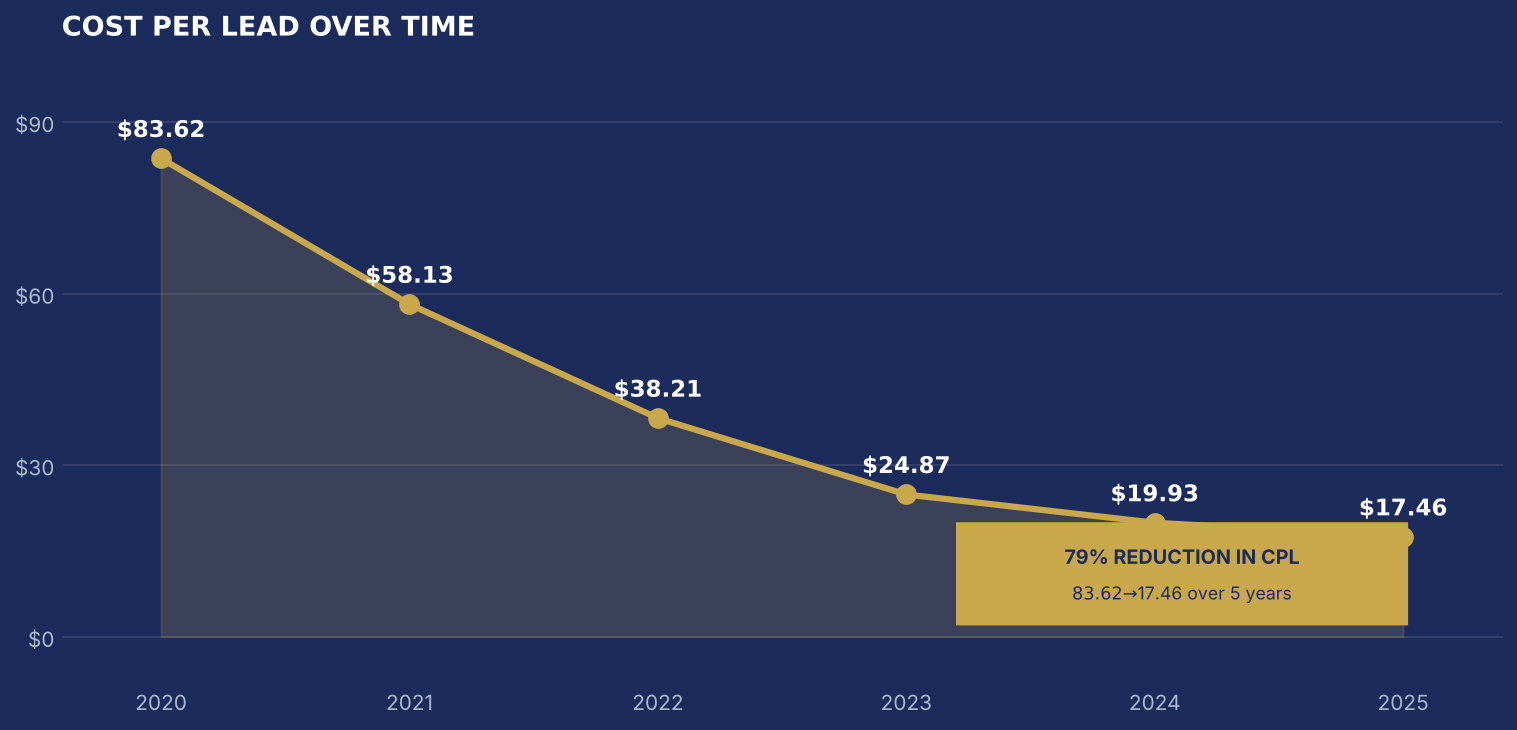
The trajectory wasn’t linear. The biggest year-over-year CPL drops happened between months 3 and 12 of the campaign — when match types were tightened, the negative keyword list expanded past 200 terms, and the first geo-targeted landing pages went live. After that, gains continued but at a steadier, compounding pace.
The 18.49% conversion rate is worth pausing on. Industry benchmarks for legal Google Ads often cite 5—10% as average. Consistently achieving 18.49% means that nearly one in five people who clicked the ad filled out a form or called. That’s not a Google Ads win — that’s a landing page and offer win, which we’ll cover in the landing page section.
Why Google Ads — and Not Social Media or Referrals
Family law clients don’t browse Instagram looking for a divorce attorney. They search. When someone needs a family law attorney, the need is immediate, specific, and tied to a life event — a spouse serving divorce papers, a custody dispute escalating, a support order that isn’t being followed.
Google captures people at that moment. Social media reaches people before they know they need you, which works for brand awareness but converts poorly for time-sensitive legal decisions. Referrals are valuable but not scalable — you can’t turn up a referral faucet the way you can increase a Google Ads budget.
Additionally, Google Ads produces measurable, attributable results. Every lead is tracked. Every dollar of spend is accounted for. That level of accountability — seeing that $17.46 produced a client conversation — is hard to replicate in referral networks or social media where attribution is murky. For a deeper look at the full family law attorney marketing picture, including Local SEO and website strategy, that guide covers all the channels.
Match Type Discipline: The #1 Driver of CPL Reduction
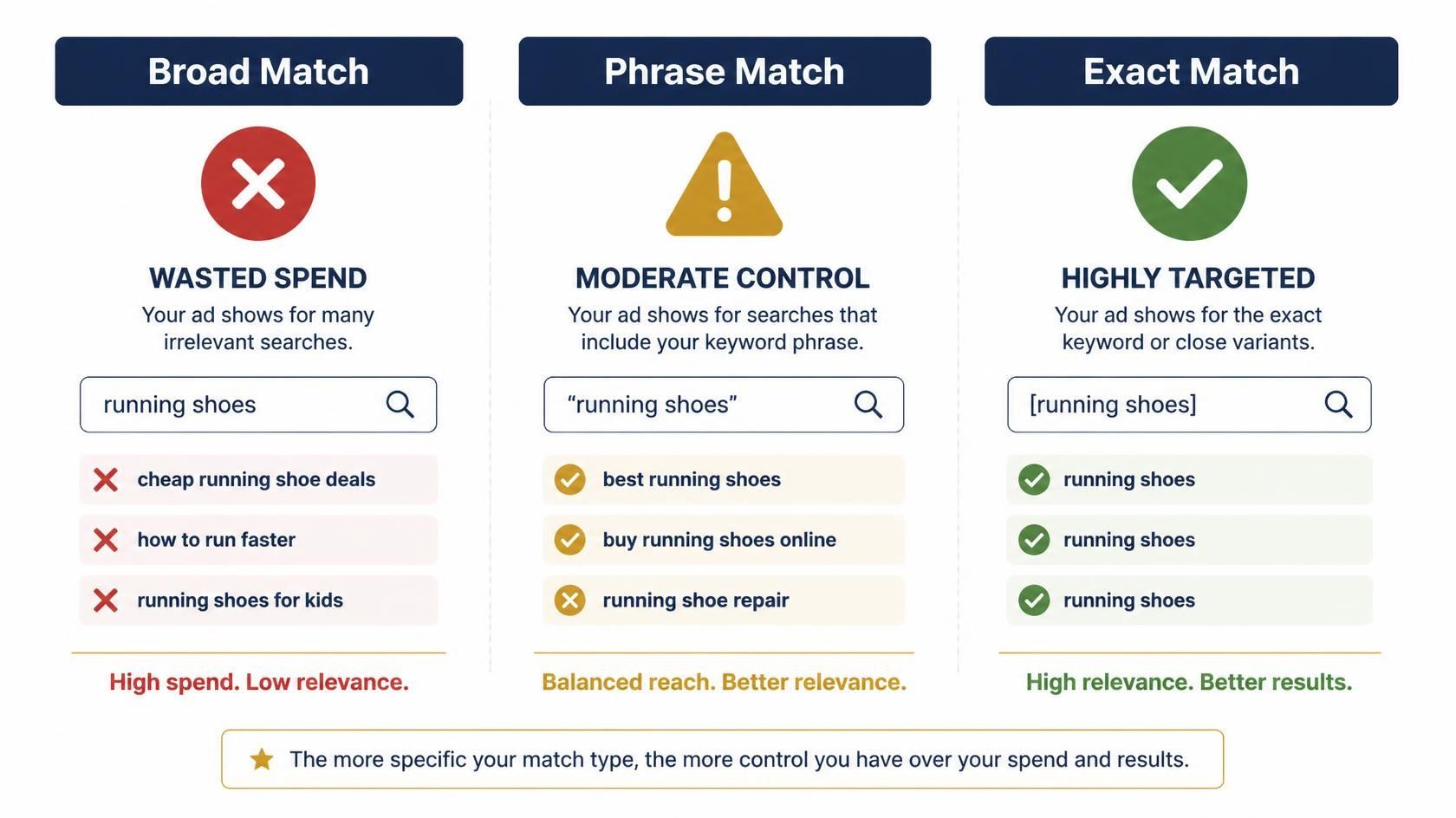
Here’s the most common mistake family law attorneys make with Google Ads: they run broad match keywords and wonder why they’re getting clicks from law school applicants, people looking for apro bono family law help,” and users researching legal textbooks. Broad match matches your keyword to anything Google considers semantically related — and Google’s definition of “related” is generous with your money.
The Match Type Hierarchy We Used
We built this campaign on a strict match type hierarchy from day one. Exact match keywords formed the foundation — high-intent, city-specific terms that captured people actively searching for a family law attorney in a specific geography. Phrase match terms expanded reach to adjacent searches while still requiring the core phrase to appear. Broad match was absent entirely until the campaign had 90+ days of data and a negative keyword list exceeding 300 terms.
— Broad Match Problems
Triggers on: “family law degree programs,” “pro bono family attorney help,” “is my husband allowed to take the kids,” “family law in Texas” (wrong state), “law school near me”
Result: Wasted budget on zero-intent traffic
— Exact + Phrase Match
Triggers on: “divorce attorney [city],” “child custody lawyer NJ,” “family law consultation [city],” “equitable distribution attorney”
Result: High-intent clicks from people ready to hire
The shift from broad match to disciplined phrase and exact match was the single largest contributor to CPL reduction in the first six months. When you stop paying for clicks from people who will never hire you, cost per lead drops — sometimes dramatically — without reducing the volume of actual prospects.
Core Keywords That Drove Results
We structured keyword groups around practice areas and geography. The best-performing clusters were divorce attorney + city combinations, followed by custody lawyer + city, and support attorney + city. These were exact match. Phrase match variants captured searches that included additional modifiers — “best divorce attorney in [city]” or “experienced family law attorney [city].”
We deliberately avoided vanity keywords like “top family law firm” or “best family lawyer” — these attract tire-kickers comparing options and rarely convert at the same rate as intent-clear searches.
Negative Keywords: Blocking the Searches That Drain Budget
Match type discipline tells Google what to target. Negative keywords tell Google what to ignore. Both are essential. Most attorneys focus only on what to bid on and ignore what to block — and that’s where budget bleeds out quietly, one irrelevant click at a time.
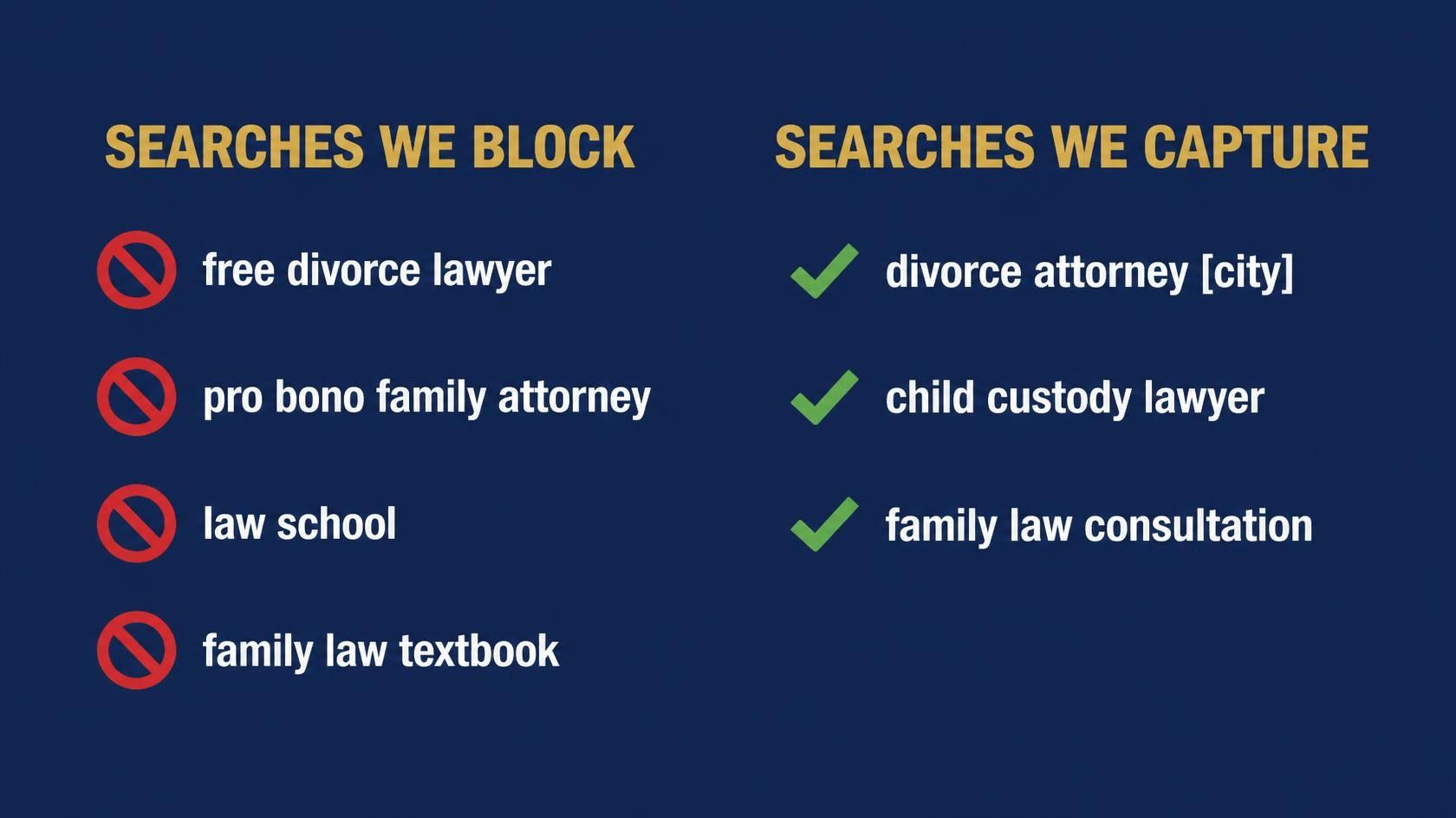
Our negative keyword list for this campaign grew from 47 terms at launch to over 380 terms by year two. The categories that mattered most:
The Negative Keyword Categories That Mattered
Informational intent: “How to file for divorce,” “what is equitable distribution,” “family law explained,” “can I represent myself in family court.” These people are researching, not hiring. Blocking them kept the budget focused on people ready to make a call.
Financial barrier signals: “Free family law attorney,” “pro bono divorce lawyer,” “affordable family law,” “sliding scale family attorney.” These searches signal someone who may not be able to afford the firm’s rates. While empathy matters, these clicks rarely convert to paying clients.
Academic and professional: “Family law textbook,” “family law degree,” “law school family law,” “family law paralegal certification.” Google’s broad match will absolutely serve your ad to these searches. Block them from the start.
Wrong geography: State names, cities, and counties outside the firm’s service area. A New Jersey firm has no use for clicks from Pennsylvania searchers — so every non-NJ state and county got added as a negative early.
Quality Score: The Compound Interest of Google Ads
Quality Score is Google’s 1-10 rating of how relevant your keyword, ad, and landing page are to each other. It determines your actual cost per click. A high Quality Score means you pay less for the same position — sometimes dramatically less. A low Quality Score means you’re paying a premium for every click.
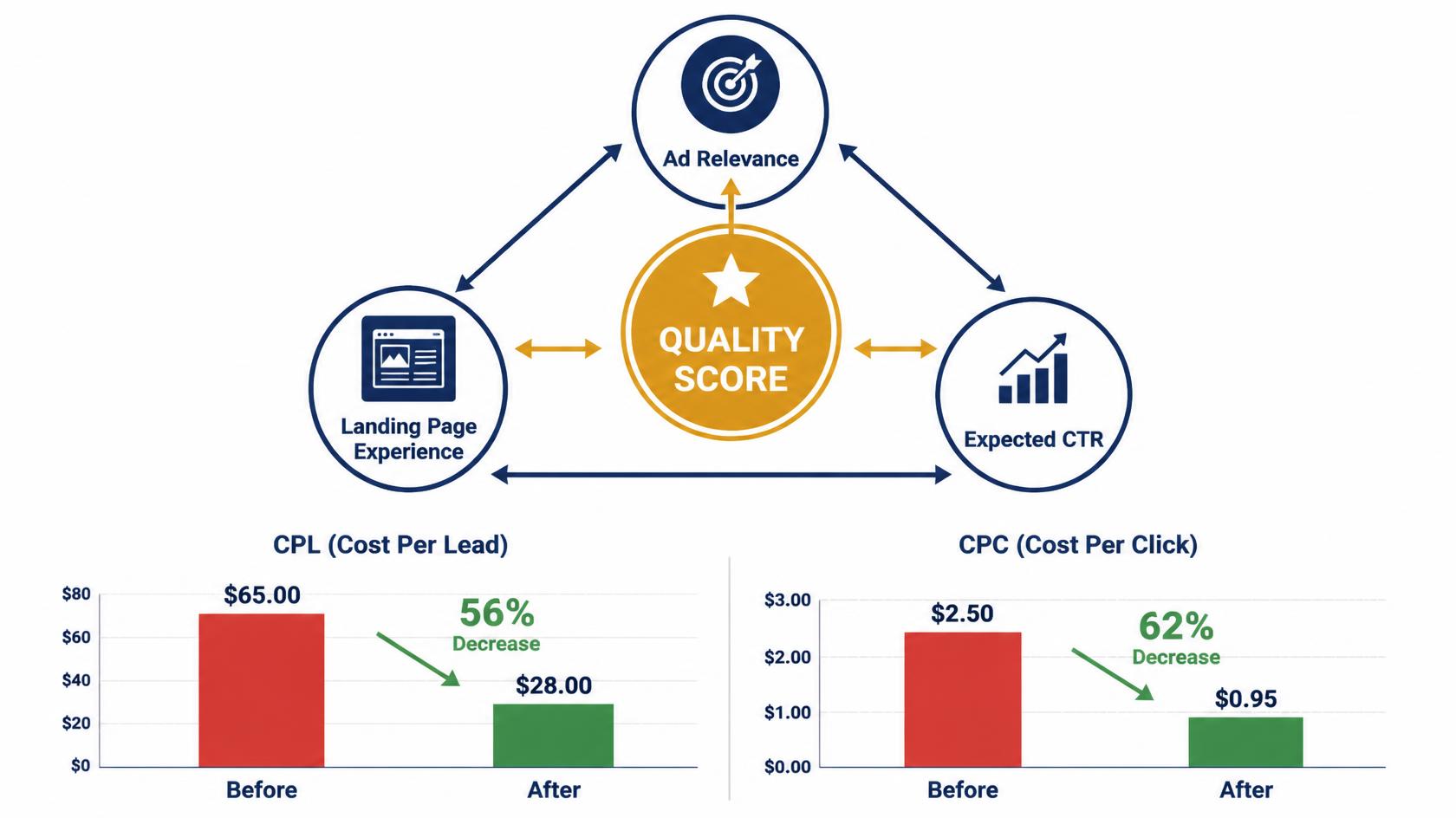
Quality Score has three components: expected click-through rate, ad relevance, and landing page experience. Each one is independently rated. Consequently, you can have high ad relevance and a strong CTR but still have a Quality Score of 4 because your landing page takes six seconds to load on mobile.
How We Built Quality Score for This Campaign
We structured ad groups tightly — one to three keywords per ad group, all targeting the same intent. “Divorce attorney NJ” had its own ad group, its own tailored ads, and its own geo-specific landing page. That tight structure meant every component of the Quality Score equation was aligned.
Furthermore, ad copy was written to mirror the exact language of the keyword. Someone searching “child custody lawyer Bergen County” saw an ad that said “Child Custody Lawyer — Bergen County, NJ” in the headline. That direct mirroring drives expected CTR up, which lifts Quality Score, which reduces CPC.
Over five years, this compounded. As Quality Scores rose from an average of 5 to an average of 8, the effective CPC dropped even when the competitive landscape heated up. That’s the compound effect — each improvement reinforces the next.
This dynamic is similar to what we describe in our criminal defense lawyer marketing guide, where the same Quality Score discipline produced a CPL drop from $787 to $15 over ten years. The mechanisms are the same across legal verticals.
Landing Pages: Where Good Traffic Becomes Bad Results
You can have perfect match types, a pristine negative keyword list, and a 9/10 Quality Score — and still get a mediocre conversion rate if your landing page doesn’t close the deal. Most family law firms send all their Google Ads traffic to the homepage. That’s a significant missed opportunity.
Generic Page vs. Geo-Targeted Page
— Generic Homepage Landing
“Welcome to Smith Family Law” — general overview of all practice areas, no city reference, no immediate call to action, five seconds to load, requires scrolling to find a form
Typical result: 4—6% conversion rate
— Geo-Targeted Landing Page
“Divorce Attorney in [City], NJ — Free Consultation” — city in H1, local phone number, trust elements (bar admission, years in practice), form above the fold, under 2 seconds load time
Achieved: 18.49% conversion rate
The shift to geo-targeted pages was one of the most impactful changes in the entire campaign. When someone searches “divorce attorney in Hackensack” and lands on a page titled “Divorce Attorney in Hackensack, NJ,” the message match is immediate and reassuring. Moreover, geo-targeting builds trust — it signals that this isn’t a national firm farming out calls to local attorneys, but a local practice that knows their area.
The Landing Page Formula That Drove 18.49% CVR
Every geo-targeted landing page followed the same structure: city-specific H1 with the primary keyword, a one-sentence value statement (“Free consultation — we’ve helped [City] residents through divorce, custody, and support matters for [X] years”), a HubSpot form or phone number above the fold, three to four trust elements (bar admission, years in practice, practice areas served), and a brief supporting paragraph. No distractions, no navigation menu pulling people away, no five-paragraph firm history.
Speed mattered too. Every page was tested for mobile load time and optimized for Core Web Vitals. A page that loads in 4 seconds versus 1.5 seconds can drop conversion rate by 30—40%. For legal clients with high CPC bids, that difference in conversion rate translates directly to a CPL that either justifies the channel or kills it.
To see how this landing page approach connects to the broader organic strategy, the family law attorney marketing guide covers Local SEO, review strategy, and how paid and organic work together.
The Three Phases of a Mature Family Law Google Ads Campaign
No campaign goes from $83 to $17 CPL overnight. Understanding the phases helps set realistic expectations and guides where to focus attention at each stage.
Phase 1: Foundation (Months 1—3)
Goal: Stop the bleeding. Shift to exact and phrase match. Build initial negative keyword list. Establish baseline conversion tracking. Launch first geo-targeted landing page.
CPL typically drops 20—30% in this phase even before ad copy optimization begins.
Phase 2: Optimization (Months 4—12)
Goal: Quality Score improvement, ad copy testing, negative keyword list expansion, geo-page rollout to all target cities. Begin dayparting analysis to find peak conversion windows.
This is where the biggest CPL drops happen. Quality Score gains reduce CPC while landing page improvements lift CVR simultaneously.
Phase 3: Scaling (Month 13+)
Goal: Expand budget into proven segments, test new practice area sub-campaigns (custody, support), introduce Performance Max with careful audience controls, monitor for Quality Score erosion.
Growth compounds here. The negative keyword list and Quality Score infrastructure from earlier phases reduce CPC even as competition increases.
Most attorneys who “tried Google Ads and it didn’t work” abandoned in Phase 1 — before the structural work had time to produce results. The first three months are the most expensive and least efficient. That’s not a sign the channel doesn’t work. It’s a sign the foundation isn’t built yet.
For attorneys considering whether Google Ads or purchased leads make more economic sense, we addressed this directly in the bankruptcy leads case study — the math on build vs. buy applies across all legal verticals.
What Marketing Practicality Delivers for Family Law Attorneys
- Match type architecture built around high-intent, exact match keywords — no broad match until the negative list is airtight
- Negative keyword management with weekly search term reviews and a list that grows past 300 terms in the first year
- Geo-targeted landing pages for every major city in your service area — the same page structure that drove 18.49% CVR for our NJ client
- Quality Score improvement plan with tight ad group structure and ad copy mirroring the keyword intent precisely
- Monthly CPL reporting with full transparency into spend, clicks, conversions, and cost trajectory
- No long-term contracts — we earn continued business by delivering results, not by locking you in
Check our free 58-point digital marketing checklist to audit your current Google Ads setup — it covers match types, landing page essentials, conversion tracking, and more. And if you want a quick read on whether your website is helping or hurting your ad performance, the free website analyzer gives you an immediate read on speed, mobile performance, and technical SEO.
Frequently Asked Questions
How much does Google Ads cost for a family law attorney?
Google Ads costs for family law attorneys vary widely, but industry averages run $100—$150 per lead. With disciplined match type management, negative keyword lists, and optimized landing pages, our NJ family law client reduced their CPL from $83.62 to $17.46 over five years — well below the industry average. Monthly spend depends on your market size and target case volume.
What keywords should a family law attorney bid on?
Focus on high-intent phrases like “divorce attorney [city]”, “child custody lawyer near me”, “family law attorney consultation”, and “divorce lawyer [city]”. Use exact match and phrase match. Avoid broad match until your negative keyword list is extensive. Add negatives for “free”, “pro bono”, “law school”, and informational queries that signal research rather than hiring intent.
What conversion rate should a family law Google Ads campaign achieve?
A well-optimized family law Google Ads campaign typically converts 10—20% of clicks to form fills or calls. Our NJ client achieved an 18.49% conversion rate across 4,684 total conversions. Conversion rate improves when landing pages are geo-specific, load fast, and match the ad’s exact promise.
How long does it take to see results from Google Ads for a family law firm?
Initial results — clicks and some leads — appear in the first two to four weeks. Meaningful cost efficiency takes three to six months as the campaign collects conversion data and Quality Score improves. The biggest CPL gains usually come in months four through twelve as negative keyword lists mature and the algorithm optimizes toward your best-performing segments.
Should a family law attorney use broad match keywords in Google Ads?
Not at the start. Broad match wastes budget on irrelevant searches — law school queries, pro bono requests, out-of-market clicks — before your negative keyword list is built. Start with exact match and phrase match. Once you have 90+ days of search term data and a solid negative list exceeding 200 terms, broad match can expand reach while controlling cost.
What landing page works best for family law Google Ads?
Geo-targeted landing pages outperform generic attorney landing pages consistently. A page specifically for “divorce attorney in [city]” — with the city in the H1, a local phone number, and a fast-loading form above the fold — consistently outperforms a generic “family law services” page. Our client’s conversion rate jumped when we moved from one generic page to geo-specific pages for each major city they served.
Start Reducing Your CPL
If you’re running Google Ads and paying more than $40 per lead, there’s room to improve. If you’re not running Google Ads yet, the data above shows what a mature campaign looks like. Either way, we can help you get there faster.
Ready to cut your family law CPL below $20?
We’ve done it. Schedule a free 30-minute strategy call and we’ll tell you what’s driving your cost up and how to fix it.
Schedule a Free Strategy Call —
Or call us at 610-998-9777
Duncan Lauder has 25 years of experience in digital marketing for law firms and trades businesses. He founded Marketing Practicality to bring the same data-driven Google Ads discipline used by large agency clients to small and mid-size legal practices. The proof points in this post come from real client campaigns managed by Marketing Practicality. Learn more about Duncan —
Family Law Google Ads: $83 to $17 CPL in 5 Years
How One Family Law Firm Cut Cost Per Lead from $83 to $17 — and Generated 871 Qualified Leads Five years of Google Ads data…
Bankruptcy Leads: Should You Buy Them or Build Your Own with Google Ads?
Bankruptcy Leads: Should You Buy Them or Build Your Own with Google Ads? A data-driven look at what purchased leads actually cost — and why…
Electrical Contractor Marketing: The Proven Guide
Electrical Contractor Marketing: The Proven System for Growing Your Electrical Business Google Ads, local SEO, and the compounding system behind electrical contractor marketing that generates…